Join Shannon Rio and Kevin Spencer for a Fall Birding Outing in the Klamath Basin on September 21st (FULL)!
Spend a full day immersed in nature as we explore the rich birdlife of Rocky Point, Fort Klamath Area, and the Wood River Wetlands.
Itinerary Highlights:
7:30 AM – Depart from Ashland (meet at Rite Aid parking lot)
9:00 AM – Arrive at Rocky Point boat ramp to scan Klamath Lake for pelicans, western grebes, green herons, and more. We’ll stroll the road until 11:00 AM, keeping an eye out for white-headed woodpeckers and migrating songbirds.
11:30 AM – Drive to Fort Klamath Area and bird from the car. Look for mountain bluebirds, red-tailed hawks, kestrels, and violet-green swallows.
1:30 PM – Arrive at Wood River Day Use Area for a gentle walk along roads and paths. Expect sightings of pygmy nuthatches, warblers, cedar waxwings, and song sparrows.
4:00 PM – Depart for Ashland
5:30 PM – Return to Rite Aid parking lot
What to Bring:
Binoculars and plenty of water
Snacks and lunch to enjoy on the go
Weather-appropriate clothing and sturdy walking shoes (we’ll walk slowly and not too far)
Whether you’re a seasoned birder or just curious about the feathered wonders of the Klamath Basin, this relaxed and scenic outing promises great company and unforgettable sightings. Let’s go birding!
A maximum of 16 people with 4 cars, each with 4 passengers.
This is a community outreach offering, so no donation is required; just come as you are! If you’d like to support us, donations of up to $100 are welcome and appreciated.
If you have accessibility questions, please don’t hesitate to reach out. You can contact Elva at ejm@klamathbird.org
This trip is full. If you would like to be added to a waitlist, email Elva at ejm@klamathbird.org.
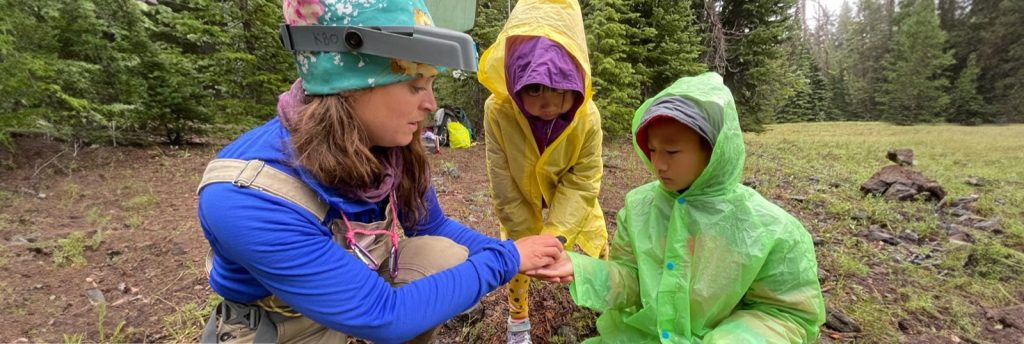
Come experience bird science in action with Klamath Bird Observatory! On Friday, September 19th, we’ll visit our banding station near Wildlife Images for a half-day, family-friendly outing. We’ll carpool from Ashland* at 6:30 a.m. and return by noon.
What to Expect
Get an up-close look at both resident and migratory birds, including fledglings from this season!
Meet KBO scientists and bird banding interns, and learn about mist netting, data collection, and the bird life cycle.
Explore career pathways in wildlife biology, ornithology, and field research, perfect for curious students and young nature enthusiasts.
Support Science & Education
This is a donation-based event, and your contributions help support our dedicated scientists and interns. We especially encourage students and young folks to attend!
What to Bring
Snacks and drinks
Sturdy shoes for uneven trails
Layers for cool morning temperatures
Optional: hiking pole for extra support
We can’t wait to share this special field experience with you. See you out there!
*If you do not live in Ashland, we will coordinate accordingly.
We would like to invite you to our second session taking place on September 2nd, 2025, from 8 am until 12 pm noon PST Via Zoom
Your organization brings invaluable outdoor experiences to communities, and your insights on community science and bird conservation will enhance the ability of the eBird platform and user experience to reach all those who may benefit from it.
Each participant will receive a $75 stipend to honor their time and contribution, which will be mailed to them. Please complete this registration form to sign up. If you have any questions, you can reach out to Elva Manquera at ejm@klamathbird.org.
The Klamath Siskiyou Oak Network (KSON) is leading a model conservation effort to protect and restore oak ecosystems in southern Oregon and northern California. Through its Strategic Conservation Action Plan, KSON is addressing threats including conifer encroachment, fire exclusion, and habitat loss with science-based, collaborative strategies grounded in Traditional Ecological Knowledge. With past and current investments of $22 million, their work is on track to restore over 10,350 acres by 2030.
Building on this local success, the Prairie, Oaks, and People Investment Strategy coordinates nine partnership initiatives across the Pacific Northwest. This regional strategy, led by the Pacific Northwest Oak Alliance, aims to protect and restore over 70,000 additional acres, further the recovery of Tipping Point species like the Lewis’s Woodpecker and Oregon Vesper Sparrow, and strengthen Tribal and rural community leadership. Together, KSON’s local leadership and the regional investment strategy represent a scalable, shovel-ready blueprint for oak and prairie conservation.
This tiered approach—local action scaling to regional impact—was recently recognized nationally in the 2025 State of the Birds Report. The report highlights the Prairie, Oaks, and People partnerships, including KSON, as a leading example of how targeted, science-driven conservation can reverse the steep declines facing grassland and oak woodland birds.
Now is the time to build on this momentum. Bold investment, sustained collaboration, and strategic scaling of proven models, such as KSON’s, can secure a future where oak and prairie ecosystems—and the communities and species that depend on them—thrive once again.
Building from Local to Regional Success: How Oak and Prairie Conservation in the Klamath-Siskiyou is Scaling Up Across the Pacific Northwest
The Klamath Siskiyou Oak Network (KSON) is a long-standing partnership working to conserve oak ecosystems in southern Oregon and northern California—a globally significant biodiversity hotspot. KSON’s 2020 Strategic Conservation Action Plan outlines a 30-year vision to restore four distinct oak habitat types: oak savanna, oak woodland, oak chaparral, and oak-conifer forests.
Conifer Encroachment by Jaime Stephens
KSON’s plan identifies the primary threats degrading these ecosystems—conifer encroachment, fire exclusion, agricultural conversion, and invasive species—and prioritizes a set of enabling and implementation strategies to address them. These strategies emphasize:
Increasing restoration efforts, such as prescribed fire and conifer thinning;
Integrating Traditional Ecological Knowledge and partnering with Tribal Nations;
Building technical capacity for restoration across public and private lands;
Monitoring progress through clear indicators tied to ecological attributes like native understory diversity, oak regeneration, and bird community composition.
KSON’s work is grounded in the principle that conservation must be collaborative and culturally informed. Since its formation in 2010, KSON has restored over 6,500 acres, investing more than $7.5 million, through close collaboration with Tribes, local agencies, NGOs, and landowners. Now, following the Strategic Conservation Action Plan, KSON is leveraging an additional $14.5 million to restore 3,850 acres on private and BLM-managed lands through the Upper Rogue Oak Initiative.
The local success of KSON offers more than a blueprint for oak conservation—it serves as the southern anchor of a much larger regional effort.
Scaling Up: The Prairie, Oaks, and People Investment Strategy
Recognizing that local success stories, such as KSON’s, must be replicated across a broader geography to achieve a meaningful and lasting impact, the Prairie, Oaks, and People Investment Strategy was developed to coordinate and scale conservation efforts across the Pacific Northwest’s oak and prairie landscapes.
Led by the Pacific Northwest Oak Alliance, this regional strategy unites nine partnership initiatives—each operating in different parts of Washington, Oregon, and British Columbia—into a shared framework for action. Together, these groups aim to protect 10,200 acres, restore 60,000 acres, recover key species, and build Tribal and community capacity over the next five years.
Lewis’s Woodpecker by Frank Lospalluto
The strategy calls for a $304 million investment focused on four main pillars:
Land Protection: Securing remaining high-value oak and prairie habitats through easements and acquisitions;
Habitat Restoration: Using ecocultural fire, invasive species management, and oak recruitment to rebuild habitat resilience;
Species Recovery: Focusing on priority bird species like Lewis’s Woodpecker and Oregon Vesper Sparrow—both recognized as Tipping Point species requiring immediate action;
Capacity Building: Expanding the workforce, tools, and funding needed to sustain long-term conservation success, particularly through Tribal leadership and local stewardship.
Importantly, the Prairie, Oaks, and People strategy connects ecological restoration with rural resilience, promoting sustainable grazing, native seed production, cultural renewal, and climate adaptation as co-benefits of habitat work.
The Klamath Siskiyou Oak Network’s local plan is nested within—and critical to—the success of this broader regional vision. Lessons learned and methods proven in the KSON geography are informing restoration priorities, investment strategies, and monitoring frameworks across the entire Pacific Northwest oak and prairie range.
National Recognition: Highlighted in the 2025 State of the Birds Report
The impact of this tiered, integrated approach has not gone unnoticed. The 2025 State of the Birds Report—the nation’s leading assessment of bird population health—specifically showcases the Klamath Siskiyou Oak Network and the Prairie, Oaks, and People strategy as outstanding examples of conservation success.
The report underscores the crisis facing oak- and prairie-dependent bird species. Western forest birds have declined by 11%, grassland birds by 43%, and oak-woodland specialists like the Lewis’s Woodpecker and Oregon Vesper Sparrow are among those identified as “Tipping Point” species, having lost more than half their populations over the past 50 years.
Yet amid these sobering trends, the State of the Birds spotlights KSON’s and the broader Pacific Northwest Oak Alliance’s work as proof that proactive, coordinated, science-based action can reverse declines. Restoration of oak and prairie systems is already helping to stabilize and increase populations of several plant and insect species. These efforts are also enhancing climate resilience, rural economic vitality, and cultural renewal.
This national recognition validates the approach: start with place-based, community-led action (like KSON’s work), scale it through regional coordination (as in Prairie, Oaks, and People), and secure broader conservation gains with tangible, measurable outcomes.
Call to Action
The intersection of the Klamath Siskiyou Oak Network Strategic Plan and the Prairie, Oaks, and People Investment Strategy—now recognized in the 2025 State of the Birds Report—shows the power of building conservation from the ground up and scaling it strategically across landscapes.
By aligning local success with regional coordination and national attention, we can restore the Pacific Northwest’s oak and prairie ecosystems, support imperiled bird species, strengthen communities, and build climate resilience for future generations.
The work ahead demands bold investment, sustained partnership, and a shared commitment to scaling what works.
Together, we can ensure that oak and prairie ecosystems—and the diverse birds, wildlife, and cultures they sustain—thrive once again.
By funding habitat protection across our National Wildlife Refuges, the Federal Duck Stamp has long shown what’s possible when people unite for wildlife. At Klamath Bird Observatory, we’re building on that legacy with our Conservation Science Stamp that highlights science-based efforts to protect habitats for all bird species. When you purchase the Conservation Stamp Set, you’re joining birders, hunters, and conservationists who believe in preserving birds and their habitats.
2025-2026 Conservation Science Stamp
The White-breasted Nuthatch (Sitta carolinensis) is a small, bluish-gray-backed songbird noted for its pure white underparts, black cap, and habit of creeping head-first down tree trunks. Both males and females share similar plumage, and they are often heard giving nasal churring calls as they forage. These birds probe bark crevices for insects and spiders and cache seeds—especially sunflower kernels and other nuts—wedged into bark fissures before hammering them open.
In the Pacific Northwest, the Slender-billed subspecies (S. c. aculeata) specializes in oak woodlands. Genetic studies suggest that this group diverged in place approximately 350,000 years ago, during the glacial-interglacial climatic shifts of the Pleistocene. It likely evolved to specialize in oak habitats during glacial periods when it was cut off from breeding with other populations of White-breasted Nuthatches by mid-continental glaciers. Today, it nests and roosts almost exclusively in the cavities of mature oak trees—and occasionally in old ponderosa pines—showing strong ties to stands with large trees (diameter at breast height >50 cm) and abundant canopy cover.
Populations of the Slender-billed White-breasted Nuthatch have fallen steadily, earning it “candidate” status in Washington and a “sensitive” designation in Oregon. Fragmentation and loss of mature oak stands, resulting from agriculture, urban development, and fire suppression, have reduced the availability of cavities and foraging habitats. Encroachment by Douglas-fir trees shade out young oaks, while invasive European Starlings and other cavity-nesters vie for nest sites, further stressing nuthatch numbers.
Conservation efforts focus on preserving and restoring large-diameter oaks, as well as their associated cavities. Land managers aim to maintain contiguous oak patches of at least 173 acres with 40–80% canopy cover, supplemented by smaller “stepping-stone” patches of 50 acres to support subpopulations. Prescribed burns help prevent conifer trees from overtaking oak woodlands, and incentive programs encourage private landowners to protect oaks and snags. Continued monitoring of populations and habitat suitability will guide adaptive management to secure the future of this charming woodland bird.
Decade of the Oak
Oaks are foundational to Pacific Northwest ecosystems, hosting some of the region’s richest biodiversity and cultural heritage. The Pacific Northwest Oak Alliance’s Decade of the Oak campaign emphasizes that oak and prairie systems once covered vast landscapes but have been reduced by up to 90 percent in places. These fire-adapted, drought-tolerant habitats support more than 300 vertebrate species, including specialized cavity-nesting birds like the White-breasted Nuthatch, which depends on oak trees for nesting in cavities and foraging for insects. By restoring and protecting large‐diameter oaks, employing prescribed fire to maintain healthy oak woodland habitat, and engaging tribal and community partners in stewardship, the Alliance aims to secure the future of both oaks and the nuthatches that rely on them.
Nora Sherwood entered the field of science illustration as a midlife career changer, having spent many years in the high-tech world. She graduated from the University of Washington’s Natural Science Illustration certificate program in the Spring of 2014 and is a full-time, self-employed artist.
Intricate details and patterns found in nature are endlessly fascinating; Nora enjoys the challenge of portraying them on paper. Watercolor – my primary medium – is a highly technical but powerful medium that allows her to construct illustrations in layers, always considering pigment characteristics and color theory to build forms and create depth. She primarily works with organizations such as museums, zoos, government agencies, consumer product companies, and academics.
There’s something special about a backyard alive with birds chirping, the flutter of wings, and the soft swish of a cat’s tail as they watch the action unfold. For nature lovers with feline companions, the dream is a backyard that welcomes birds while keeping cats safely and happily occupied.
With thoughtful planning, your outdoor space can become a vibrant, shared habitat where birds thrive, and cats stay content.
Grow It and They Will Come: Plants Birds Love in Ashland
Native plants are the backbone of any bird-friendly garden. They provide natural food sources, nesting material, and shelter; plus, they’re beautifully adapted to Southern Oregon’s climate. In Ashland, hardy native plants offer year-round support for feathered visitors.
Blooming Oregon Grape (c) Frank Lospalluto
Bird-attracting favorites include:
Serviceberry: A small tree or shrub with spring flowers, summer berries, and colorful fall foliage.
Red-Flowering Currant: Hummingbirds adore its bright pink blossoms in early spring.
Oregon Grape: This evergreen shrub features nectar-rich flowers and deep blue berries that birds adore.
Snowberry: Snowberry is helpful to pollinators as a host and a food source. The flowers attract Anna’s and rufous hummingbirds, and several birds have been observed eating the berries, such as towhees, thrushes, robins, grosbeaks, and waxwings. Birds also use snowberry thickets for cover.
Showy Milkweed: Excellent for pollinators and birds that snack on the insects it attracts.
Planting with seasonal variation in mind—flowers in spring, berries in summer and fall, and seedheads through winter—keeps birds coming year-round.
The More Layers, the More Birdy Your Yard Becomes
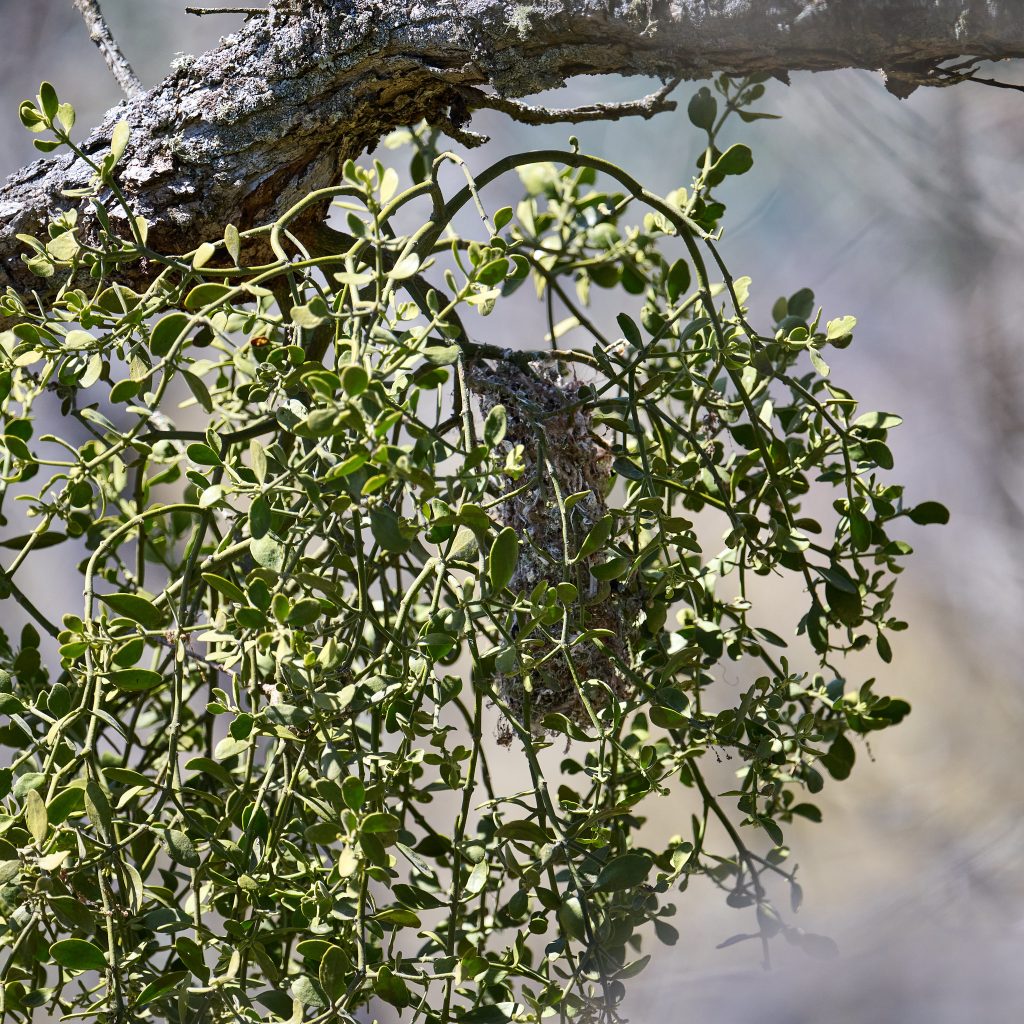
Bushtit nest in mistletoe (c) Frank Lospalluto
Birds thrive in layered landscapes that consist of tall trees, mid-sized shrubs, and ground covers that mimic wild habitats.
Tall trees (like oaks or conifers) offer perching, nesting, and lookout spots.
Mid-level shrubs provide dense cover for safety and feeding.
Ground covers provide support and shelter for foraging and sheltering shy species like towhees.
Adding logs or rock piles to your landscape draws in insects, which in turn provide a vital food source for birds. These natural features also create shelter for ground-foraging birds such as robins and thrushes.
Bath Time: Why Birds Love a Little Splash Zone
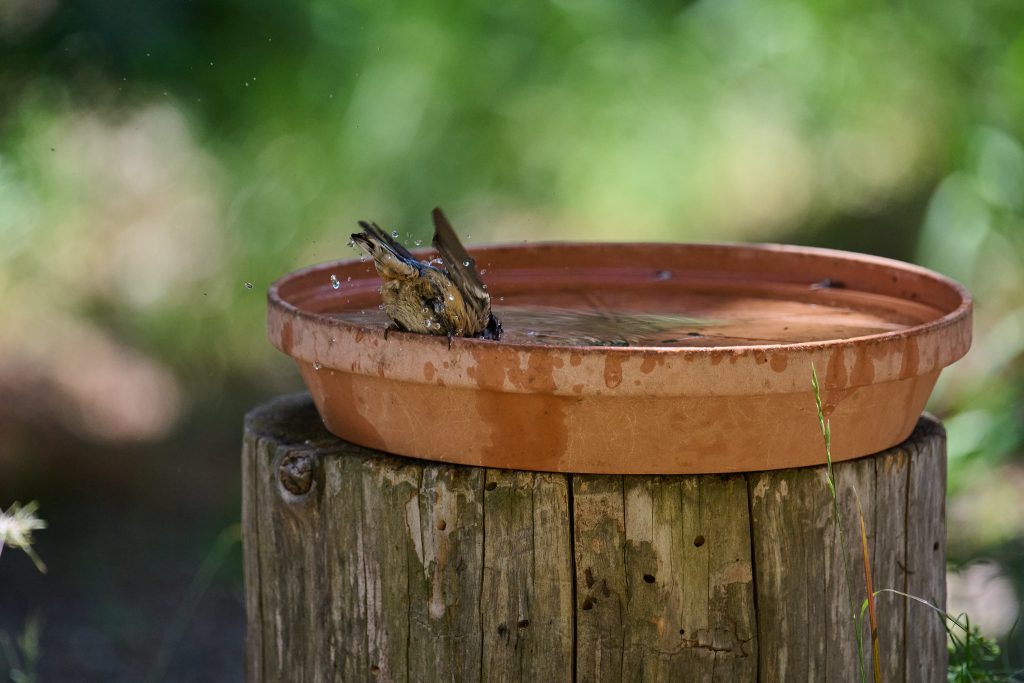
Red-breasted Nuthatch enjoying a birdbath (c) Frank Lospalluto
Water is essential for birds, especially in Ashland’s drier months. Adding a bird bath, shallow pond, or fun flowing fountain invites birds to drink, bathe, and play.
Tips for a successful bird splash zone:
Keep the water shallow (1–2 inches) with sloped edges.
Add pebbles or stones for perching.
Place baths in open areas with nearby shrubs for quick escape routes.
Clean and refill frequently to prevent algae and mosquito larvae.
To keep both birds and cats safe, avoid placing water features right next to bushes where predators might hide.
Feeding Birds Without Feeding the Squirrels (or Cats!)
Feeding stations are a fun way to support local birds and watch them up close. But a thoughtful setup is key.
Tube feeders deter squirrels and larger birds.
Suet feeders are great in winter and attract insect-eaters like woodpeckers.
Platform feeders provide a stage for jays and doves, but place them high and far from accessible areas.
Choose black oil sunflower seeds and thistle seeds to attract a range of native birds. And don’t forget: Clean feeders every couple of weeks to prevent disease.
Purrfect Balance: Let Your Cat Enjoy the Outdoors Without Endangering Wildlife
We love our cats, but free-roaming cats are a major threat to bird populations. They’re also at risk themselves from traffic, predators, and disease. Cats can enjoy the outdoors without harming wildlife.
Try:
Leash walks or harness time in the backyard.
Window perches for indoor bird-watching.
The Ultimate Win-Win: A Catio!
When it comes to giving your cat safe outdoor access while keeping birds out of harm’s way, nothing beats a catio —a secure, enclosed outdoor space designed specifically for cats. It’s the best of both worlds: cats get fresh air, sunshine, and mental stimulation, while birds stay safe from surprise pounces.
Now, the big question is: DIY or Hire a Professional?
DIY Catios
If you’re handy with tools and enjoy weekend projects, a DIY catio can be a fun and budget-friendly way to create an outdoor haven for your cat. From simple window box enclosures to freestanding jungle gyms, there are plenty of tutorials and kits available online to get you started.
Pros:
Budget-friendly
Customizable
Great for small spaces
Considerations:
Requires time, tools, and construction confidence
May need extra planning to blend with your landscape or home style
2. Professionally Built Catios
If building isn’t your thing—or you want something more permanent and polished—a professional catio builder can bring your dream design to life. You can utilize companies that specialize in crafting custom catios that are safe, stylish, and built to last.
Pros:
Expert craftsmanship and materials
Fully customized design
Built to meet local weather and safety needs
Considerations:
Higher cost (but often worth it for long-term durability and design)
Whether you build it yourself or hire the pros, a well-placed catio can blend in beautifully with a bird-friendly yard. Just be sure to position it near, but not directly in, high-traffic bird zones, as cats love watching, but birds need a little breathing room.
Harmony in Your Habitat
To tie it all together, a few final touches will boost your yard’s ecosystem power:
Avoid pesticides and herbicides as they harm birds and the insects they eat.
Reduce lawn space and replace it with native plants or ground cover.
Keep outdoor lights low or motion-activated to minimize disruption to nocturnal migration.
With a bit of planning, your backyard can be a vibrant, safe, and beautiful space where birds thrive, cats stay happy, and you get to enjoy the best of both worlds.
Whether you’re a newcomer to the region or an old-timer, participate in a fun and information-filled auto tour led by historian/author Jeff LaLande and noted birders Frank Lospalluto (a KBO consultant) and Stacy Taeuber (a KBO Board member).
Lots of history: The car-pool route will include various “History Stops” (but relatively little actual walking) at such important places as Railroad Tunnel #13 (site of the infamous and tragic DeAutremont Brothers’ botched train robbery of 1923); the old Siskiyou Pass; Grouse Gap shelter (just past Mt. Ashland); the 1850s-1860s “Mountain House” stage stop; the 1846 Applegate Trail; the Hill-Dunn cemetery; and other spots — i.e., returning the “back way” (through the upper-most Bear Creek Valley) to Ashland by mid-afternoon.
Corn Lily taken by Frank Lospalluto
Birding among the wildflowers! Along the Siskiyou Crest, we’ll hike a short stretch of the Pacific Crest Trail near Mt. Ashland. Wildflowers – lupine, gilia, Oregon sunshine, corn lily, and many other species may be in profusion, and we will identify and enjoy as many of the flowers and trees as we can. Various raptors should be spotted, as well as many other birds, ranging from migrant Green Towhees along the section of the Pacific Crest Trail to Bullock’s Orioles and Acorn Woodpeckers down at Emigrant Lake’s historic Hill-Dunn cemetery. We’ll also encounter and discuss lots of fascinating geology along the way.
Note: This event is limited to 25 people. We will travel in a car-pool “caravan” of up to personal vehicles (with up to four people in each vehicle). Bring your binoculars, lunch, drinking water, or other beverages, and your questions for Frank, Stacy, and Jeff. And feel free to share your knowledge about what we see!
When: Sunday, July 13, 8:30 AM. (We will be back in Ashland by no later than 4:30 and likely well before that.)
Where: Meet at the Rite Aid parking area (off Ashland Street, past Tolman Creek Rd) in the lot’s northeast corner. (Car-pooling will be necessary to keep the group to as few vehicles as possible.)
El Observatorio de Aves de Klamath y el Instituto de Poblaciones de Aves se complacen en anunciar el lanzamiento de la primera mitad de la Guía de Identificación de Aves de Norteamérica, también conocida como la Guía Pyle, en español. Este logro facilita el acceso a un valioso recurso para los anilladores de aves de toda America.
Conocida como la “biblia del anillamiento de aves”, la Guía Pyle es un recurso esencial en todas las estaciones de anillamiento, donde generalmente se observa con sus páginas desgastadas por el uso constante.
Acompáñenos en una presentación por Zoom con el editor y traductor de la guía, Rafael Rueda Hernández, quien compartirá la experiencia de llevar este texto esencial a los anilladores de habla hispana. El evento tendrá lugar el 18 de junio a las 12:00 p. m. (hora del Pacífico).
Rafael Rueda-Hernández is a Mexican ornithologist with over two decades of experience in bird banding, avian field research, and teaching. He is a leading expert on molt in Neotropical birds, with numerous peer-reviewed publications on the subject. His work has made significant contributions to understanding molt strategies, age determination, and bird migration across the Americas. Rafael has held research and editorial roles at institutions in Mexico and the U.S., and currently serves as Co-Editor-in-Chief of the Journal of Field Ornithology. He led the efforts to translate the Pyle Guide into Spanish, bridging the gap in expert knowledge for the Spanish-speaking ornithological community.
Start your summer off right with a unique and super fun experience at beautiful Upper Klamath Lake on Monday, June 16th! This is a half-day, family-friendly outing to a Klamath Bird Observatory bird banding station only 1.5 hours from Ashland.
You will learn about and see our resident and migrant birds up close. You will also interact with KBO scientists and our bird banding interns. This is an opportunity to learn about the science of bird banding, including mist netting, data collection, and the life cycle of birds. For young people interested in a career with wildlife, ornithology, or fieldwork in general, this is a fantastic opportunity to see science in action.
This is a donation-based event with a suggested donation of $0 to $75 for this unique and very special opportunity. We especially encourage young folks and students to attend! The event is from 6:00 am to noon, inclusive of driving time. If you are from the Klamath Falls area, we can arrange to meet you at Rocky Point instead of Ashland. Please bring snacks, water, or other drinks. Wear sturdy shoes and layers as it will be cool in the early morning.


 The
The 


 The report underscores the crisis facing oak- and prairie-dependent bird species. Western forest birds have declined by 11%, grassland birds by 43%, and oak-woodland specialists like the Lewis’s Woodpecker and Oregon Vesper Sparrow are among those identified as “Tipping Point” species, having lost more than half their populations over the past 50 years.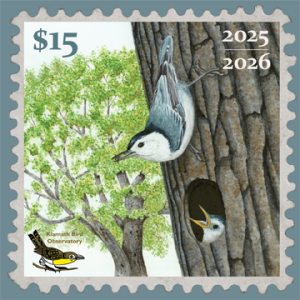

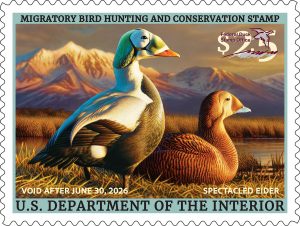 By funding habitat protection across our National Wildlife Refuges, the Federal Duck Stamp has long shown what’s possible when people unite for wildlife. At Klamath Bird Observatory, we’re building on that legacy with our Conservation Science Stamp that highlights science-based efforts to protect habitats for all bird species. When you
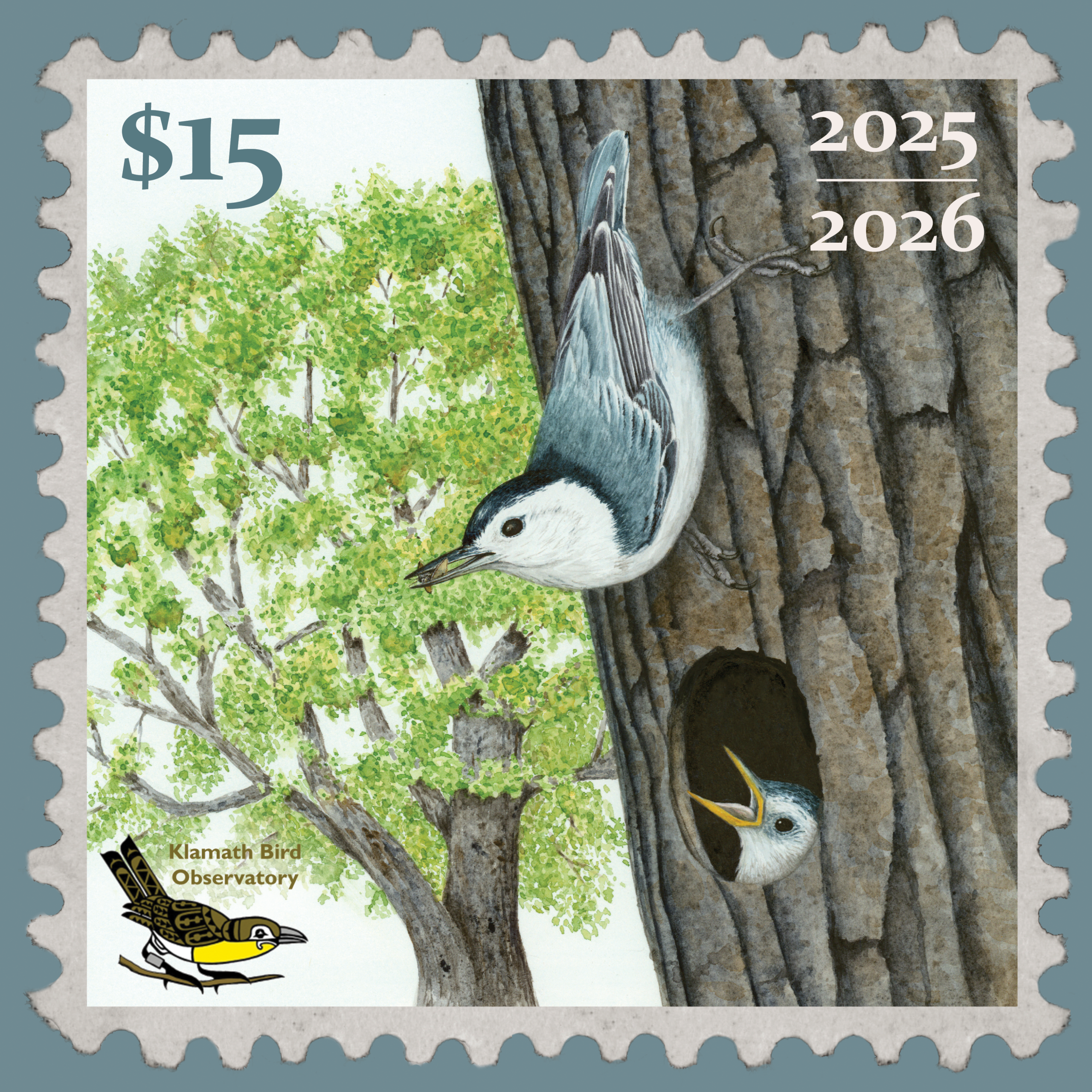 The White-breasted Nuthatch (Sitta carolinensis) is a small, bluish-gray-backed songbird noted for its pure white underparts, black cap, and habit of creeping head-first down tree trunks. Both males and females share similar plumage, and they are often heard giving nasal churring calls as they forage. These birds probe bark crevices for insects and spiders and cache seeds—especially sunflower kernels and other nuts—wedged into bark fissures before hammering them open.
 Oaks are foundational to Pacific Northwest ecosystems, hosting some of the region’s richest biodiversity and cultural heritage. The
  Nora Sherwood entered the field of science illustration as a midlife career changer, having spent many years in the high-tech world. She graduated from the University of Washington’s Natural Science Illustration certificate program in the Spring of 2014 and is a full-time, self-employed artist.

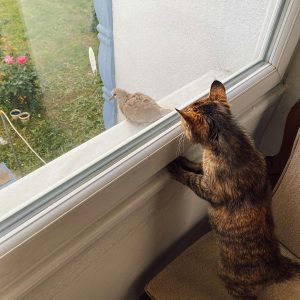 There’s something special about a backyard alive with birds chirping, the flutter of wings, and the soft swish of a cat’s tail as they watch the action unfold. For nature lovers with feline companions, the dream is a backyard that welcomes birds while keeping cats safely and happily occupied.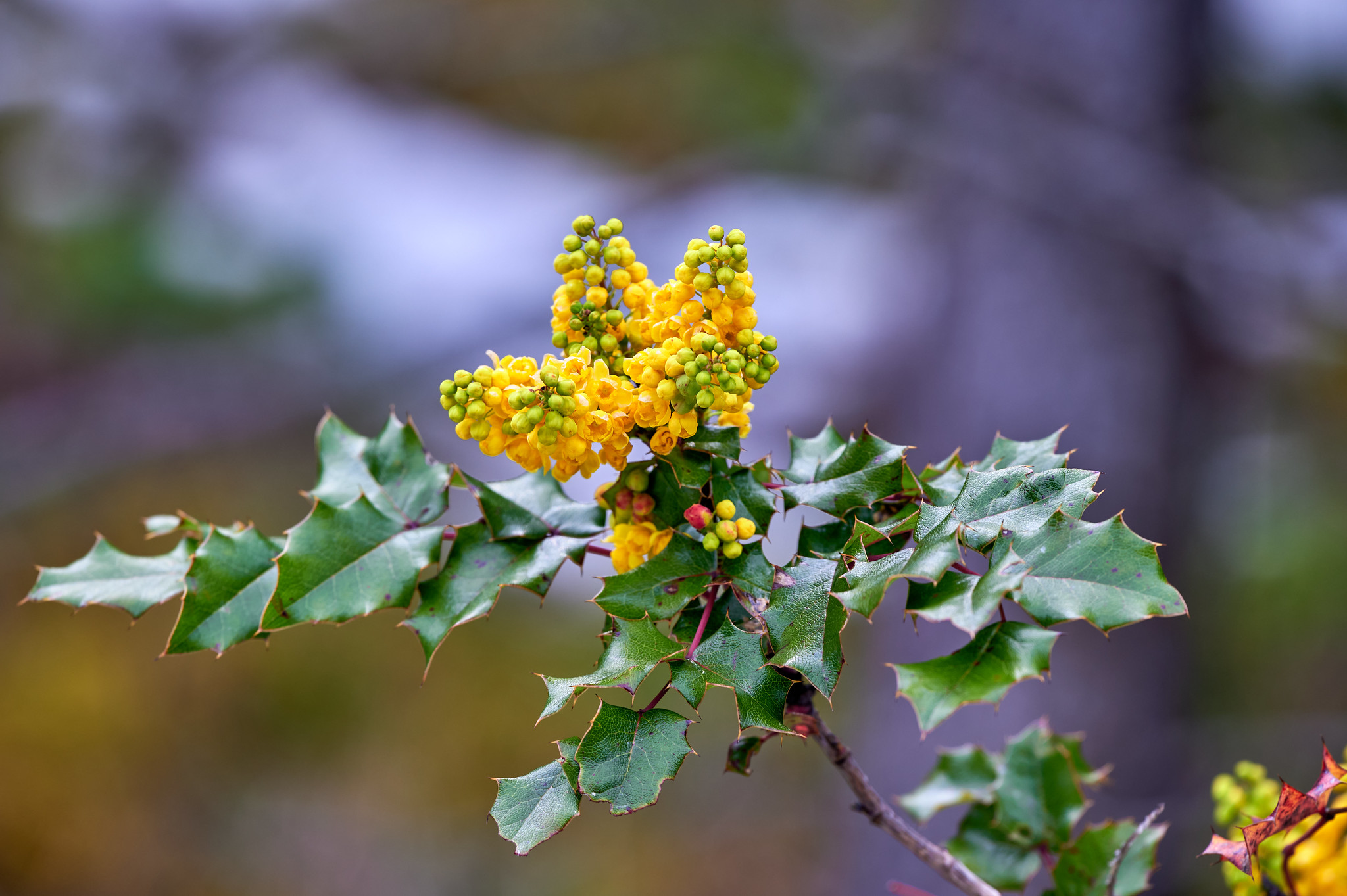
 Now, the big question is: DIY or Hire a Professional?

 Whether you’re a newcomer to the region or an old-timer, participate in a fun and information-filled auto tour led by historian/author Jeff LaLande and noted birders Frank Lospalluto (a KBO consultant) and Stacy Taeuber (a KBO Board member).