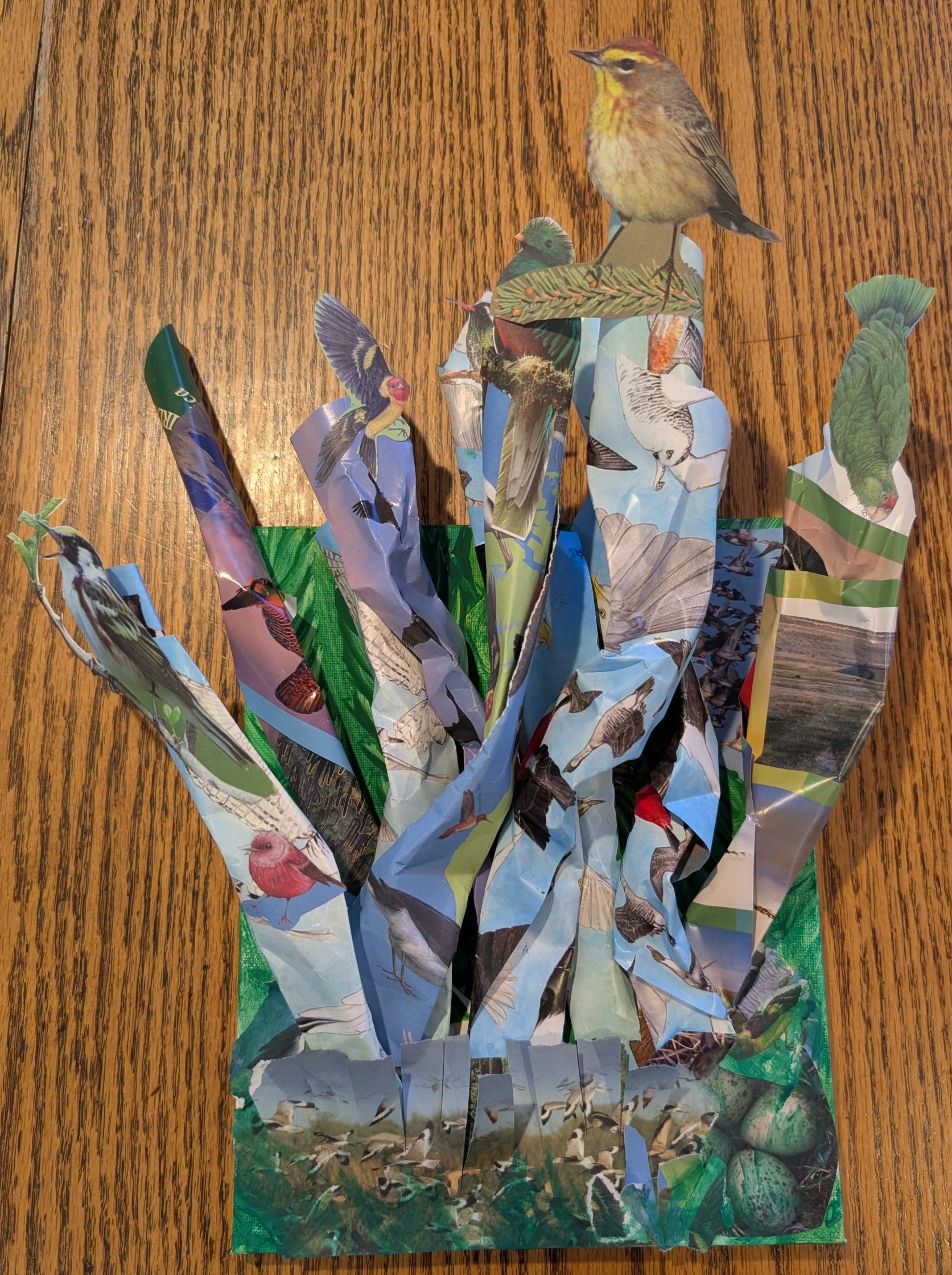
Art made during the last Artistic Reflection event. Using old State of the Birds Reports.
Join the Klamath Bird Observatory and local artist Gatore Mukarhinda on April 12th from 4 pm to 6 pm for an afternoon of creativity and conservation. We will have a shared creative space where we make bird‑inspired art together and explore how eBird turns our observations into conservation.
Both artmaking and community science begin with noticing. When someone sketches a bird, builds a collage of feathers and colors, or paints a migration path, they are practicing the same attentive seeing that powers eBird checklists. Each act, creative or scientific, asks people to look closely, to care about what they see, and to share it with others.
We will be using the community space at Luna Cafe. There will be live music and light refreshments. All craft materials will be provided, but feel free to bring additional craft materials for your project.
Cost: $10 per adult, $5 per child, registration required
Refunds can be issued upon request. Please note that processing fees charged at the time of the original transaction are non‑refundable and will be withheld from the total refund.
Join Klamath Bird Observatory and the eBird NW Steering Committee to learn more about a new community science project, Project Phoenix on August 23rd at noon PCT. In the age of mega-fires, people and wildlife are increasingly exposed to hazardous smoke. Although birds are highly sensitive to air pollution, we know very little about how smoke affects birds. Learning more is critical to inform bird conservation in a rapidly warming world and you can help us.
Project Phoenix is open to all birders and bird enthusiasts – regardless of previous birding experience. They welcome and encourage beginner birders to participate. If you’re a beginner, welcome!
These surveys are completed year-round, but data collected during the breeding season are KBO’s current focus of analysis. While migration and winter habitat are also essential for birds, it’s easier to obtain reliable bird counts during the breeding season because male birds sing consistently to attract mates and mark their territories. Survey data are collected and stored using eBird NW, an easy-to-use tool for community scientists and professional biologists to input bird sightings and contribute to a worldwide database.
Yellow Warbler (c) James Livaudais
The surveys were done at seven sites between Central Point and Ashland. Five of those sites were burned during the 2020 Almeda and Central Point Fires, providing a unique opportunity to observe the changes in bird populations immediately after a fire and long-term post-fire recovery. In spring 2021, there was a notable difference between birds considered habitat generalists and riparian specialists. American Robin, a ground-foraging generalist, was equally or more abundant in burned sites than unburned sites. At the same time, riparian specialists Yellow-breasted Chat and Yellow Warbler were much more common in unburned sites in the post-fire conditions of 2021. By 2022, there had been substantial regrowth of willow, ash, and cottonwood seedlings that these species can use as nesting and foraging habitat. American Robin abundance decreased, while Yellow-breasted Chat and Yellow Warbler increased or remained stable across most sites.
A set of 13 focal bird species were identified to help assess habitat quality along Bear Creek. The species used are expected to be common in a healthy riparian habitat in southern Oregon. In 2022, only one of the seven sites had ten or more focal species in sufficient numbers: North Mountain Park. This gave Bear Creek Greenway a poor rating. This isn’t unexpected with the Greenway being located in a relatively urban setting and the impact of the 2020 fires on riparian vegetation. This snapshot of Bear Creek riparian bird population health may improve with natural vegetation regrowth, and active restoration efforts are underway. Bear Creek Community Bird Survey data will provide a measuring stick for tracking future changes in bird populations that may occur due to ongoing restoration efforts (or adverse effects of habitat loss, climate change, etc.).
The results of this effort will be combined with other metrics collected by RRWC or other partners (water quality parameters, fish abundance, fish habitat accessibility, affordable housing, air quality, etc.) to create a Rogue River Basin Report Card that will be useful for tracking watershed and community conditions, as well as for community outreach. The first report card is scheduled for release in Spring 2023. In 2023, RRWC plans to expand the current survey to additional watersheds in the Rogue River Basin.


 Join Klamath Bird Observatory and the eBird NW Steering Committee to learn more about a new community science project,

