Tag: Klamath Bird Observatory

Community Education Events Offered by KBO Board Members and Friends

Photo (c) 2015 Graham Lewis

Interested in learning more about the diverse birds of the Klamath-Siskiyou region this fall? Klamath Bird Observatory Board Members and friends are offering lectures and classes on topics ranging from birds and climate change to attracting and feeding birds in your yard.

Don’t forget to mark your calendars for a lecture or sign up for a class.


CANARY IN THE COAL MINE, BIRDS AND CLIMATE CHANGE

  • Thursday October 15th from 5:30-6:30 at the SOU, Hannon Library
  • Free lecture given by Harry Fuller

The following classes are taught at North Mountain Park in Ashland and sign ups are through www.AshlandParksandRec.org:

EXPLORING MINDFUL BIRDING

  • Wednesday September 16th 6:30-8pm with Saturday 19th 8:30-10am field trip
  • $20
  • Taught by Shannon Rio and Kate McKenzie

HAWKS!

  • Tuesdays October 6, 13, 20 from 7-8:30pm
  • $25 for the series
  • Taught by Dick Ashford

LEARNING ABOUT BIRDS

  • Wednesday October 14th 6:30-8pm
  • $15
  • Taught by Shannon Rio

LEARNING MORE ABOUT BIRDS

  • Wednesday October 21st from 6:30-8pm
  • $15
  • Taught by Shannon Rio

ATTRACTING AND FEEDING BIRDS IN YOUR YARD

  • Tuesday November 10 from 6:30-8pm
  • $20
  • Taught by Vince Zauskey

New study shows how wildfire changes forests and the birds that live there a decade after a mixed-severity fire in southwest Oregon

Quartz Fire in 2013, 12 years after the fire, with a healthy shrub understory and standing dead trees.  Photo copyright Jaime Stephens.

PRESS RELEASE — FOR IMMEDIATE RELEASE

AUGUST 17, 2015

Contact: Jaime Stephens, jlh@klamathbird.org, 541-944-2890

Ashland, Oregon: As much of the West is experiencing drought-related wildfire, new research on the effect of wildfire on forests and bird communities has just been released. Researchers from Klamath Bird Observatory just published results from a 10-year study looking at the effects of the 2001 Quartz Fire that burned in southwest Oregon. They found that not only did the forest structure change dramatically over time, but the bird community changed as well, with many species benefitting from the fire, a finding that was only obvious at the end of the 10- year period. In addition, the researchers documented the role of the fire’s severity showing that for half of the species affected by the fire their response was dependent on fire severity more so than simply whether the area was burned.

This study is important because it looks at the interacting effects of fire severity and time since fire, and provides forest managers with scientific evidence of how wildfire can create a forest that meets the needs of both wildlife and forest management, especially as forest restoration efforts are increasing. Their results are published in the journal The Condor: Ornithological Applications (http://www.bioone.org/doi/abs/10.1650/CONDOR-14-58.1?journalCode=cond&).

The Quartz Fire of 2001 burned over 6000 acres of mixed conifer broad-leafed forest (a mix of conifers and trees such as Pacific madrone and black oak). Wildfires are an important part of southwest Oregon forests, and usually burn in a pattern called mixed-severity – which means the fire burns unequally, in a patchwork of lightly to heavily burned areas interspersed with unburned patches. The resulting mosaic is important for wildlife and healthy forests.

“One important takeaway from our study was the interaction of fire severity and time since fire. Often, fire-related studies measure the short-term impact and compare only burned versus unburned areas, however, in this case, we saw bird species that initially decreased, increasing by the end of the study and doing so with greater magnitude in areas that were more severely burned,” says Jaime Stephens, Klamath Bird Observatory’s Science Director and the study’s lead author.

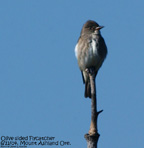
Olive-sided Flycatchers are often associated with burned forests, where open habitat, in combination with standing dead trees, creates abundant foraging opportunities.  Photo copyright James Livaudais.

Some of the birds that increased over the longer term were species like the Olive-sided Flycatcher, a species of conservation concern in the West. Immediately after the fire, this species was decreasing, but over time, it increased because areas that burned with high-severity resulted in standing dead trees where the flycatchers nest, and a shrub understory re-growth that provided the flycatchers with ample insect food. The House Wren, Lazuli Bunting, and Lesser Goldfinch had a similar story – they increased in areas that were burned and more so with increasing fire severity. The length of the study shed light on how a forest recovers from a mixed severity burn, detecting patterns that otherwise would have gone unnoticed.

“After more than 100 years of fire suppression, and now exacerbated by the effects of climate change, our forests may be at-risk of burning at uncharacteristically high severities. Today, forest managers are trying to remedy this problem with thinning and controlled fire, however, these common techniques sometimes fail to replicate the impact of a natural wildfire,” says Jaime Stephens, Science Director, Klamath Bird Observatory.

“The findings of this study can inform management actions, particularly when objectives relate to maintaining or improving ecosystem function” says Jena Volpe, Fire Ecologist, Bureau of Land Management. “Additionally, having long-term post-fire data, relevant to southwest Oregon, greatly improves our understanding of vegetation succession and fuel condition changes across our diverse landscape.”

So what does the study mean for forest management? The challenge of managing western forests in the face of climate change, drought, and a history of fire suppression is not easy. Results from this study show the importance of management techniques that mimic conditions created by a mixed-severity fire: a patchwork forest type, an abundance of snags, and allowing natural regeneration of shrubs. Using these techniques will make it more likely future fires will burn in a mosaic pattern as well, which will benefit birds and create healthy forests for years to come.

This study was funded by the Joint Fire Sciences Program, Rogue River-Siskiyou National Forest, Bureau of Land Management Medford District, and Secure Rural Schools and Community Self-Determination Act of 2000 Title II.

Klamath Bird Observatory (www.klamathbird.org) is fueled by partner-driven science programs. We use birds as indicators of the healthy and resilient ecosystems on which we all depend. Our science involves three integrated aspects: 1) long-term monitoring, 2) theoretical research, and 3) applied ecology. We bring our results to bear through science delivery involving partnership driven engagement in conservation planning, informing the critical decisions being made today that will have lasting influences on the health of our natural resources well into the future. Klamath Bird Observatory’s award-winning model was developed in the ruggedly beautiful and wildlife-rich Klamath-Siskiyou Bioregion. We now apply this model more broadly throughout the Pacific Northwest. Plus, our intensive professional education and international capacity building programs expand our influence into Mexico, Central and South America, and the Caribbean.

Click here for a PDF of this press release.

Click here for a press packet with a PDF of this press release and high resolution images.

##############

Recently published paper describes meaningful ecological units (i.e., Management Domains) for collaborative conservation in the Klamath Region

NAJ***SCIENCE BRIEF AND NEWS RELEASE – FOR IMMEDIATE RELEASE ***

August 14, 2015 – For Immediate Release

Contact: John Alexander, jda[AT]klamathbird.org, 541-890-7067

Patterns of plant, amphibian, mammal, and bird distribution have been used to identify ecological boundaries in the Klamath Region of southern Oregon and northern California, one of the most biophysically complex areas in North America. These patterns are described in a paper, recently published in the Natural Areas Journal, written by collaborators from the National Park Service, US Geological Survey, Klamath Bird Observatory, and other organizations. “This paper represents our first collaborative effort to link biogeography with protected areas management in the Klamath Region,” says the papers lead author, Daniel Sarr (formerly with the National Park Service and now working with the US Geological Survey). John Alexander, Klamath Bird Observatory’s Executive Director and a co-author on the paper added, “In the Klamath Region, natural resource managers are challenged with managing the complex array of environments that characterize the area. In this paper, we describe patterns that help delineate meaningful ecological units, or Management Domains, that are intended to advance collaborative natural resource management in the Region.”

The distributions of species described in the paper illustrate conceptual and spatial domains for natural areas management that provide an eco-regional framework for collaborative conservation. The paper describes a Maritime Management Domain in the western portion of the Region that is similar to other coastal areas. To the east, a Great Basin Domain that is similar to other Great Basin environments is also described. While conservation management approaches that have been tested in other areas of the west coast and Great Basin may be effectively applied in these two Domains, a third Eastern Klamath Management Domain, at the core of the Klamath Region, is more unique and presents novel management challenges. This third Domain has higher species richness and endemism than other environments in the western United States that are climatically similar, such as the southwest. Because the area is so unique, management approaches that have been successful in other areas may not be as easily applied in the Eastern Klamath Management Domain. Lead author Daniel Sarr explains further, “Because of its exceptional spatial complexity, it has not always been clear how management concepts and approaches developed in other areas of the West can best be used in the Klamath Region.”


However, the species that characterize the Eastern Klamath Domain may be the key to the conservation and management of natural areas in the Klamath Region. The Klamath Region will likely serve as an important refugia for a number of at-risk species that may become more threatened by climate change. Therefore management intended to help the Region’s unique array of native species persist into an uncertain future is becoming a priority. This paper presents an improved understanding of how such species are distributed across the region which, in combination with knowledge about the species’ habitat needs, can help inform design of the novel management approaches that may be needed in the Klamath Region.

Dr. Sarr concluded the following about these research results, “This new paper represents ongoing efforts to identify spatially explicit management domains and serves as a step forward. The work will undoubtedly be refined through ongoing observational science efforts being conducted by the Klamath Bird Observatory, National Park Service, and other regional partners.”

To access a copy of this new publication, Comparing Ecoregional Classifications for Natural Areas Management in the Klamath Region, USA in the Natural Areas Journal contact John Alexander (jda[AT]klamathbird.org, 541-890-7067) or click here.  Click here to view a PDF of this Science Brief and News Release.

———————————————-

About Klamath Bird Observatory

Klamath Bird Observatory, based in Ashland, Oregon, advances bird and habitat conservation through science, education, and partnerships. Klamath Bird Observatory is fueled by partner-driven science programs. We use birds as indicators of the healthy and resilient ecosystems on which we all depend. Our science involves three integrated aspects: 1) long-term monitoring, 2) theoretical research, and 3) applied ecology. We bring our results to bear through science delivery involving partnership driven engagement in conservation planning, informing the critical decisions being made today that will have lasting influences on the health of our natural resources well into the future.

Klamath Bird Observatory’s award-winning model was developed in the ruggedly beautiful and wildlife-rich Klamath-Siskiyou Bioregion. We now apply this model more broadly throughout the Pacific Northwest. Plus, our intensive professional education and international capacity building programs expand our influence into Mexico, Central and South America, and the Caribbean.

#################

KBO Director interviewed for Rufous Hummingbird article featured in the Taos News

Rufus Hummingbird (c) Jim Livaudais 2002

Excepts from an interview with KBO Executive Director John Alexander were quoted in an article written by Meg Scherch Peterson and published in the Taos News. The article brings attention to the conservation challenges facing this miraculous migratory hummingbird.

Alexander describes the Rufous Hummingbird as “an indicator of habitat features that are important for the hardwood understory of the forest.” He talks about the species’ population declines and its preferred breeding habitat that is often associated with wildfire.  In the article Alexander relates KBO science to post-wildfire management – “The science suggests we allow the forest to evolve naturally through successional stages. In the past, we’ve often bypassed these stages.”  Alexander expresses concerns about best available science not being used to inform management.

Click here to read this Taos News article about Rufous Hummingbirds.

Study results represent the first published documentation of El Niño’s influence on the survival of a resident tropical landbird and suggest that mature, un-fragmented forests may offer refuge in a changing climate

Oecologia July 2015

*** SCIENCE BRIEF AND NEWS RELEASE ***

*** FOR IMMEDIATE RELEASE ***

June 23, 2015

Contact: Jared Wolfe, jdw[AT]klamathbird.org, 262-443-6866

Habitat alteration due to forest clearing and climate change threaten wildlife populations across the globe. To better understand the interacting effects of habitat degradation and climate on bird populations, researchers from the U.S. Forest Service Pacific Southwest Research Station (PSW), Klamath Bird Observatory, and Costa Rica Bird Observatories spent 12 years studying the White-collared Manakin, a fruit-eating tropical bird, in mature and young forests along the Caribbean coast of Costa Rica. During the study, several El Niño and La Niña events—cycles of warm and cold ocean temperatures that influence air temperature and precipitation—resulted in very marked dry and wet annual conditions that allowed researchers to measure differences in manakin survival relative to climatic shifts. Results were recently published as the cover article in the journal Oecologia July 2015 edition.

In young tropical forests, researchers found dramatic decreases in manakins’ survival during dry weather associated with El Niño. Researchers believe that, due to a sparser canopy and their fragmented nature, the young forests were more susceptible to understory drying that reduced fruit production. Conversely, manakins’ survival rates were higher during wet years associated with La Niña events in these young forests where increased moisture and sun exposure likely led to an abundance of fruit resources. In mature forests, researchers observed very stable manakin survival rates regardless of climatic shifts, suggesting a relatively constant abundance of fruit resources.

“The complex structure of mature forest is thought to serve as a climatic refuge, buffering fruiting plants from climatic changes resulting in stable manakin survival,” says Jared Wolfe, a postdoctoral researcher with PSW and Klamath Bird Observatory and the study’s lead author. “Climatic refuges, such as mature tropical forests, may be important for many resident tropical bird species faced with the decreasing availability of mature forests coupled with increases in the severity of El Niño-associated dryness.”

These study results represent the first published documentation of El Niño’s influence on the survival of a resident tropical landbird. Researchers believe that variation in manakin survival between forest types provides insight into the sensitivity of certain species to habitat alteration. “From a management perspective, understanding how climatic events affect biodiversity is critical for the development of science-based conservation strategies,” says Pablo Elizondo, the Costa Rica Bird Observatories’ executive director and co-author of the study.

This publication represents an ongoing collaboration between Klamath Bird Observatory, the US Forest Service Pacific Southwest Research Station and International Programs, and the Costa Rica Bird Observatories.

To view the Oecologia paper click here.

Click here to view a pdf of this science brief and news release.

#################

SCIENCE BRIEF – High ranking priority conservation areas concentrated in the Klamath-Siskiyou Bioregion

Areas where the density-based Zonation analysis produced high rankings were concentrated in the southwest of the study area in the Klamath-Siskiyou Bioregion.

A new paper published in the journal Conservation Biology presents results from a novel conservation planning approach.  This approach uses detailed data that predict the density of bird species across landscapes, as opposed to probability of occurrence models more typically used in conservation planning.  These density-based models are better suited for identifying the highest priority conservation areas.  The models were used to identify priority conservation areas in the Pacific Northwest.  The results show a concentration of high ranking conservation areas in the Klamath-Siskiyou Bioregion.  The Klamath-Siskiyou Bioregion is recognized as an area of great biological diversity and as an important area for avian diversity.  This new paper further demonstrates that the Klamath-Siskiyou Bioregion stands out as an important area for conservation focus.

This newly released Conservation Biology paper, titled Improving Effectiveness of Systematic Conservation Planning with Density Data represents collaboration among scientists from Klamath Bird Observatory, American Bird Conservancy, and Point Blue Conservation Science and was made possible with funding from the North Pacific Landscape Conservation Cooperative and data contributed from many Avian Knowledge Network partners.

Collaborative Partnerships and Data Sharing Result in Novel Approach for Better Conservation Planning

*** SCIENCE BRIEF AND NEWS RELEASE – FOR IMMEDIATE RELEASE ***

June 17, 2015

Contact: John Alexander, jda [AT] klamathbird.org, 541-201-0866 x1#

A recent study published in the journal Conservation Biology makes a strong case for a new approach to conservation planning that uses much more robust data sets in order to better protect birds, plants, and animals. The concept is fairly simple, but won’t work unless scientists can agree to share data across studies.

“Right now, we primarily only use presence and absence data for species when conservation planning for large landscapes. Much of this is due to the cost and time of collecting more comprehensive data,” said the study’s lead author, Sam Veloz, climate adaptation group leader at Point Blue Conservation Science. “We can do a much better job of conservation planning if we include data on individual species richness, not just whether they are present.”

To illustrate this point, a research collaboration including authors from Point Blue, American Bird Conservancy, and Klamath Bird Observatory encouraged partners to make their detailed bird observation data accessible through the Avian Knowledge Network.  Members of the Oregon/Washington Partners in Flight bird conservation community rallied to the call and over 900,000 new bird observations from 23 different studies were contributed to the Avian Knowledge Network through the Avian Knowledge Northwest node.  These data were then combined with bird data from the California Avian Data Center and used to develop both presence/absence species distribution models and density models covering coastal Northern California, Oregon and Washington for 26 species of land birds representing four different habitat types.  These models are freely available as part of the Pacific Northwest Climate Change Avian Vulnerability Tool available at Avian Knowledge Northwest.

To demonstrate the value of this large and detailed dataset, the Point Blue, American Bird Conservancy, and Klamath Bird Observatory researchers mapped conservation priority areas based on both the presence/absence and density models and compared the estimated population size protected in priority areas mapped using each method. “As expected, we found that the prioritizations based on count data protected more individuals of each species than the prioritizations based on presence/absence data in the areas of highest conservation priority,” Veloz said.

Veloz sees the main challenge is getting scientists from across the conservation spectrum to share their high-quality count data of individual species, no matter the study size, so planners can have as broad a dataset as possible when drawing up conservation plans. “This study shows the value of researchers sharing their data. We can combine and recycle data from multiple studies, and re-use it to answer larger conservation questions,” Veloz said. “If we all worked together to share data, we could better prioritize and protect important habitat.”

This study was funded by the North Pacific Landscape Conservation Cooperative.

To access this paper click here:

ConBi Paper

Full citation: Veloz, S., Salas, L., Altman, B., Alexander, J., Jongsomjit, D., Elliott, N., Ballard, G. 2015. Improving effectiveness of systematic conservation planning with density data. Conservation Biology. http://onlinelibrary.wiley.com/doi/10.1111/cobi.12499/abstract.

This news release adapted from Point Blue Conservation Science June 10, 2015 Press Release.

Klamath Siskiyou Oak Network to Host Oak Woodland Restoration Field Day

<img class="size-full wp-image-2850" src="https://klamathbird.org/wp-content/uploads/2015/06/Acorn-Woodpecker-c-2015-Livaudais-72dpi-3xX.jpg" alt="Acorn Woodpecker (c) 2015 Jim Livaudais" width="216" height="288" title=" Acorn Woodpecker
(c) 2015 Jim Livaudais” />

*** PRESS RELEASE — For Immediate Release ***

On June 27, 2015 the Klamath Siskiyou Oak Network (KSON) will host an Oak Woodland Restoration Field Day, designed to provide an opportunity for landowners and land managers to learn about oak restoration on their lands. This half-day event will be held at several properties in the Colestin Valley between Ashland and Yreka, where a large-scale private lands oak conservation partnership program has been underway for the past decade. A series of presentations by restoration professionals, agency managers, wildlife biologists, and private landowners will highlight current oak restoration and management approaches, the habitat value of oaks for birds and other native wildlife, and how landowners can access technical resources and funding for restoration.

The KSON partnership conserves oak habitats on private and public lands in the Klamath-Siskiyou Bioregion of southern Oregon and northern California. KSON partners include non-governmental organizations, local state and federal agencies, Native American tribes, and private citizens. The Oak Woodland Restoration Field Day represents an important part of KSON’S goal to promote oak conservation and restoration by providing opportunities for practitioners and community members to engage on issues affecting threatened oak habitats. KSON members from Lomakatsi Restoration Project, Klamath Bird Observatory, Bureau of Land Management, Natural Resource Conservation Service, US Fish and Wildlife Service, and US Forest Service will be present to offer their unique perspectives on oak restoration. This event will be an excellent opportunity for landowners and managers to meet others who share an interest in habitat conservation and restoration of oak savannas and woodlands, and to discuss the best ways to preserve these precious natural resources into the future.

The Field Day is free, but space is limited and registration is required. This event is planned for 8:30 am to 2:30 pm, and participants will need to provide their own lunch. For more information, including registration and carpool information from Ashland or Yreka, or for more information about KSON, please contact KSON Coordinator Kate Halstead at 541-201-0866 ext 7#, or at keh@klamathbird.org.

INFORMATION CONTACT:
Kate Halstead, Biologist & KSON Coordinator
Klamath Bird Observatory
keh@klamathbird.org
541-201-0866, ext 7#

Click here to view pdf of this press release.

Click here to view event flyer.

Click here to download print quality image of Acorn Woodpecker (c) 2015 Jim Livaudais.

##########

KBO’s 2015 Bullock’s Rose Oriole Volunteer Award Goes to Sandy Jilton

*** NEWS RELEASE — FOR IMMEDIATE RELEASE ***

June 1, 2015

Contact: Marcella Rose Sciotto, admin@klamathbird.org, 541-201-0866

Klamath Bird Observatory is proud to announce that Sandy Jilton is the first recipient of our new
Bullock’s Rose Oriole Volunteer Award.

Sandy Jilton receiving award from KBO's Marcella Sciotto

This award has been established to recognize individuals who demonstrate outstanding service as volunteers helping Klamath Bird Observatory fulfill its mission to advance bird and habitat conservation through science, education, and partnerships. Sandy Jilton is being recognized as the recipient of the Bullock’s Rose Oriole for her efforts to help make the Klamath Bird Observatory’s 2nd annual Mountain Bird Festival a success.

The Mountain Bird Festival is a community education event designed to foster the stewardship ethic needed to ensure thriving landscapes for humans and wildlife. This Festival represents a significant volunteer effort with nearly 50 community members chipping in over 1,200 volunteer hours to help put the event on. These volunteers help Klamath Bird Observatory staff with field trips, registration, vendors, planning, and much more.

Klamath Bird Observatory recognizes Sandy Jilton with the first Bullock’s Rose Oriole Volunteer Award

for her volunteer work that was essential to the success of this year’s Festival. Sandy worked tirelessly

to coordinate our food and drink vendors. She spent hours to find the right vendors who best

represented our region’s food and beverage culture. She then worked with them to ensure their

participation benefitted their businesses while also helping us to meet the conservation oriented goals

of the Festival. In addition to this core aspect of her volunteer role, Sandy was always eager to help out

in any way that she could. Her endless enthusiasm, good cheer, and skillful execution made her a

delight to work with.

Over the past two years bird enthusiasts from all over the U.S. have flocked to Ashland, Oregon for

Klamath Bird Observatory’s award winning Mountain Bird Festival. The Festival is designed to raise funds

for bird conservation while celebrating the role citizens play in conservation as well as the glory of the

birds and wildlife of southern Oregon and northern California. The Festival offers more than 35 field

trips that explore portions of the Cascade and Siskiyou Mountains, as well as the Klamath Basin, Shasta

Valley, the Klamath River, the Rogue watershed, and birding hotspots in and around Ashland and

Medford. Each year, more than 120 participants, many of which traveling from out of the area, come to

see some of southern Oregon’s unique bird species, and to contribute to bird conservation. In addition

to these contributions, participants spend an estimated $70,000 on lodging, meals, entertainment, and

more, demonstrating that birding means business and that the Mountain Bird Festival offers significant

economic benefits to our region.

By name, Klamath Bird Observatory’s new Bullock’s Rose Oriole Volunteer Award honors Stephanie

Bullock, the Festival’s 1st Volunteer Coordinator, and Marcella Rose Sciotto, the Mountain Bird Festival

Coordinator, who has made this Festival a successful volunteer-driven event.

Click here to read Talent’s News & Review profile and article on Sandy and her accomplishments.


######################

2015 Mountain Bird Festival May 29-31

2015 Mountain Bird Festival: Citizens and Science Elevating Bird Conservation

OfficialArtwork_2014MountainBirdFestival_GaryBloomfield

The 2014 Mountain Bird Festival was a huge success.  All attendees served as bird conservationists by helping raise over $10,000 in support of local and national conservation efforts and the science that drives that conservation. Participants flocked from all over the U.S. to bird the Klamath-Siskiyou Bioregion of southern Oregon and northern California. 171 bird species were seen by festival participants, including mountain and pacific northwest specialties such as White-headed Woodpecker, Spotted Owl, Calliope Hummingbird, Mountain Bluebird, and of course, the Great Gray Owl. Additionally, over 90 species of wildflowers were seen in bloom, as well as 21 species of dragonflies and damselflies seen zipping through the region’s diverse habitats. All data from field trips were entered into eBird Northwest, which contributes to our understanding of bird distribution and habitat use. All festival attendees purchased a Federal Migratory Bird Hunting and Conservation Stamp (a.k.a. the Duck Stamp) with their registration, contributing to wetland restoration and conservation throughout the United States; attendees also purchased a Conservation Science Stamp, supporting Klamath Bird Observatory‘s worldwide efforts to advance bird and habitat conservation through science, education, and partnerships.

This 2015 Conservation Science Stamp will feature the stunning White-headed Woodpecker!

The 2015 Mountain Bird Festival will offer guided bird walks, fine art galleries, local wine, microbrew, and food vendors, and a feel-good community atmosphere.  This year’s keynote speaker will be Cornell Laboratory of Ornithology’s International eBird project leader, Brian Sullivan. Brian will show us how eBird and its state of the art technologies are revolutionizing birding, making this popular recreation a powerful conservation science activity.

Festival registration includes half-day or full-day field trips offered on both Saturday and Sunday.

Festival goers will have the opportunity to enjoy all that is offered by the town of Ashland, Oregon. See a play at the Oregon Shakespeare Festival, stroll through town to visit a variety of shops and galleries, get a massage, or enjoy a meal at one of Ashland’s many restaurants that feature local foods. We look forward to seeing you at the 2015 Mountain Bird Festival.

The Klamath Bird Observatory is grateful for your support and dedication.  Don’t forget to tell your friends about this great opportunity to see wonderful birds and contribute to their conservation while at it!