Author: KBO

Klamath Bird Newsletter Winter 2016 Released

The Winter 2016 Klamath Bird newsletter is hot off the presses! In this issue we look at how KBO is having an impact on bird and habitat conservation … and why that is important. There are reflections of the applied and theoretical research, long-term monitoring, and education we are doing. There is also a new bird bio, upcoming events, a special thank you to our donors, and a new feature – Words on the Wind (a celebration of birds in literature). The edition also features several bird photos by Jim Livaudais, master nature photographer. Look! Come see it all in the Winter 2016 Klamath Bird!

Click here to view the entire edition of the Klamath Bird newsletter.

Enjoy!

Migratory Bird Flyway Ambassadors Stopover in Ashland!

Artwork of the USFWS Migratory Bird Treaty Centennial campaign. The art style, known as “Graffiti Bird,” will be infused into the BirdTrippers website, t-shirts worn by the ambassadors, and other outreach materials.

2016 marks the Centennial of the first Migratory Bird Treaty, the cornerstone of international joint efforts to conserve birds that migrate across the United States and neighboring countries. In celebration of 100 years for this benchmark conservation agreement, Migratory Bird Flyway Ambassadors, are spreading their wings and words following the flyways the great bird migrations this spring. Christian McWilliams and Jean Carlos Rodríguez, interns with Environment for the Americas, are practicing science and education on their northward migration.

The Pacific Flyway Ambassadors have stopped over to roost in Ashland, Oregon this week. They are visiting the U.S Fish and Wildlife Service Forensics Laboratory and Klamath Bird Observatory for exchanges of information about challenges and solutions in bird conservation. They were guests on Jefferson Public Radio’s Jefferson Exchange Wednesday morning … you can listen to their segment here.

Christian and Jean are known as the BirdTrippers and invite everyone to follow their incredible journey through blogs and social media posts as they migrate up the Pacific coast. Their inspiration will be the landscapes and people of National Wildlife Refuges, National Parks and other wildlife hot spots, as well as Urban Bird Treaty Cities, and other large communities. Through their storytelling, they are highlighting extraordinary bird facts, threats and challenges birds face and innovations of thought and design they discover on their journey that are contributing to a brighter future for birds. You can follow Jean here and Christian here.

There are BirdTrippers travelling in all the migration flyways of North America this spring. You can learn more about the Migratory Bird Flyway Ambassadors Program and all the ways you can follow them here. The Migratory Bird Flyway Ambassadors Program is supported by many partners including U.S. Fish & Wildlife Service, Environment and Climate Change Canada, National Audubon Society, Environment for the Americas, Bureau of Land Management, National Park Service, and U.S. Forest Service.

It’s Not Too Late for Spring Talks and Walks

Great Gray Owl (c) 2016 Jim Lividais

Sorry!  All the Spring 2016 Talk and Walk Classes are Sold Out!  Please Stay Tuned for Upcoming Summer and Fall Classes.

If you have not yet registered for Klamath Bird Observatory’s spring Talks and Walks don’t worry, there is still time and limited space is still available! Please join us for an outing learning the birds of the Rogue Valley, exploring local Ashland hotspots, admiring the woodland birds of Jacksonville or searching for the majestic Great Gray Owl with local experts.

Click here to read more information about each class to choose which one is right for you. The Talks are held on Thursday evenings (except for the Jacksonville Woodlands class) at the KBO headquarters in Ashland and the Walk is held on the following Saturdays (except the second Great Gray Owl trip). To register contact Shannon Rio by eMail (shannonrio[AT]aol.com) — the registration fee is $25 for each class. Don’t miss these fun and informative adventures in birding!

Due to popular demand a second Walk has been added for the Great Gray Owl class:

Talk

Thursday MAY 5, 2016 6:30PM-8PM

Presented by Shannon Rio (KBO Board President)

KBO headquarters, Lincoln School, 320 Beach Street, Ashland, Oregon

Walk

Tuesday MAY 10, 2016 2PM-dark

Led by Lee French (Rogue Valley birding expert)

Outing is an afternoon in search of the Great Gray Owl upon the Cascades Plateau east of Ashland.

SEEKING TO FILL TWO BIOLOGIST POSITIONS – TO JOIN THE KBO TEAM

Klamath Bird Observatory has announced two new full-time permanent positions – Research Biologist and Biologist – to begin Spring 2016.

Review of applications will begin on March 15th and continue until the positions are filled. The job announcements are below … with details including position descriptions, duties, qualifications and how to apply.

We are a small nonprofit organization – having a big impact in the advancement of bird and habitat conservation through science, education, and partnerships. Consider joining our team and please help spread the word.

KBO Job Announcement Research Biologist

KBO Job Announcement Biologist


Upcoming Talk and Walk Classes

Sorry!  All the Spring 2016 Talk and Walk Classes are Sold Out!  Please Stay Tuned for Upcoming Summer and Fall Classes.

Klamath Bird Observatory’s popular Talk and Walk classes continue through the winter and into Spring. The Talks are held on Thursday evenings (except for the Jacksonville Woodlands class) at the KBO headquarters in Ashland and the Walk is held on the following Saturdays. To register contact Shannon Rio by eMail (shannonrio[AT]aol.com) — the registration fee is $25 for each class. Don’t miss these fun and informative adventures in birding!


WINTER BIRDS OF THE ROGUE VALLEY

Great Gray Owl (c) 2016 Jim Lividais

Talk
Thursday MAY 5, 2016 6:30PM-8PM
Presented by Shannon Rio (KBO Board President)
KBO headquarters, Lincoln School, 320 Beach Street, Ashland, Oregon
Walk
Saturday MAY 7, 2016 2PM-6PM
Led by Lee French (Rogue Valley birding expert)
Outing is an afternoon in search of the Great Gray Owl upon the Cascades Plateau east of Ashland.


The TALK AND WALK classes offer a great chance to learn about birds, go on an outing with a bird guide expert, and visit Klamath Bird Observatory’s current headquarters. This workplace is offered to KBO through a partnership with the Ashland School district and provides our scientists and educators a space to work, collating our findings, applying for grants, and dreaming about how to study and protect birds and their habitats. Part of our dream is to someday have a new home — a place to continue our work and hopefully a site for banding, for educating, and for furthering conservation.

Seeking to Fill Positions: Bird Monitoring Student Volunteer Internships on the Trinity River

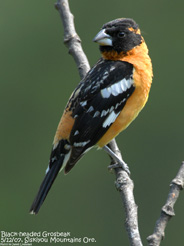
Black-headed Grosbeak (c) Jim Livaudais 2015
Klamath Bird Observatory (www.klamathbird.org) will fill up to five student volunteer internship positions on the Trinity River in northern California. You do not need to be enrolled as a student to apply for this position, however, this student internship is designed to offer an academic learning opportunity. The student volunteer interns will participate in the bird monitoring component of a large restoration project on the Trinity River in northern California from ~April 11 – August 1. This is a fantastic opportunity to gain exposure to an array of ornithological field methods while working on a high profile restoration project in a beautiful part of the world.

EXPECTATIONS: Primary duties are nest searching/monitoring, spot map surveys, re-sighting color-banded birds, target netting and color banding riparian passerine focal species, and vegetation surveys. Additional duties include completing paperwork, entering data, maintaining equipment and housing, participating in riverine float surveys, and other tasks as required. Field training in protocol methodology, bird ID, and orienteering with compass and GPS will be provided early in the field season.

QUALIFICATIONS: All applicants should demonstrate a strong interest in birds, natural history, and field biology, and should be prepared to work long days in the field in hot and inclement weather, follow prescribed protocols, be meticulous in collecting and recording data, be in good physical condition, work well both independently and with others, possess good communication skills, and have a valid Driver’s License; ability to drive a manual vehicle is preferred but not required. Applicants must be willing to work in areas of poison oak, Himalayan blackberry, and biting insects, with the potential to encounter rattlesnakes, black bears, and cougars. It is essential that the applicant be comfortable and capable of working independently both at remote sites and in areas where interaction with the public is likely. Preference will be given to those with previous experience in ornithological field methods and orienteering. Two of the five intern positions require proficiency at banding small passerine birds, and preferably experience with color-banding. The three additional intern positions do not require banding experience, however those interns will have the opportunity to assist in target netting efforts.

COMPENSATION: These are volunteer intern positions, with a monthly stipend of $750 for reimbursement of living expenses, plus field housing in the Weaverville area, provided. Binoculars will be available if needed. We will provide field vehicles, but some personal vehicle use may occasionally be required. If so, you will be reimbursed for per-mile transportation costs.

APPLICATION: Send cover letter (including dates of availability and whether you have a personal vehicle), résumé, and contact information for three references, preferably by email, to Ellie Armstrong (eea@klamathbird.org). Applicants will be reviewed until the positions are filled.

New study shows how wildfire changes forests and the birds that live there a decade after a mixed-severity fire in southwest Oregon

Quartz Fire in 2013, 12 years after the fire, with a healthy shrub understory and standing dead trees.  Photo copyright Jaime Stephens.

PRESS RELEASE — FOR IMMEDIATE RELEASE

AUGUST 17, 2015

Contact: Jaime Stephens, jlh@klamathbird.org, 541-944-2890

Ashland, Oregon: As much of the West is experiencing drought-related wildfire, new research on the effect of wildfire on forests and bird communities has just been released. Researchers from Klamath Bird Observatory just published results from a 10-year study looking at the effects of the 2001 Quartz Fire that burned in southwest Oregon. They found that not only did the forest structure change dramatically over time, but the bird community changed as well, with many species benefitting from the fire, a finding that was only obvious at the end of the 10- year period. In addition, the researchers documented the role of the fire’s severity showing that for half of the species affected by the fire their response was dependent on fire severity more so than simply whether the area was burned.

This study is important because it looks at the interacting effects of fire severity and time since fire, and provides forest managers with scientific evidence of how wildfire can create a forest that meets the needs of both wildlife and forest management, especially as forest restoration efforts are increasing. Their results are published in the journal The Condor: Ornithological Applications (http://www.bioone.org/doi/abs/10.1650/CONDOR-14-58.1?journalCode=cond&).

The Quartz Fire of 2001 burned over 6000 acres of mixed conifer broad-leafed forest (a mix of conifers and trees such as Pacific madrone and black oak). Wildfires are an important part of southwest Oregon forests, and usually burn in a pattern called mixed-severity – which means the fire burns unequally, in a patchwork of lightly to heavily burned areas interspersed with unburned patches. The resulting mosaic is important for wildlife and healthy forests.

“One important takeaway from our study was the interaction of fire severity and time since fire. Often, fire-related studies measure the short-term impact and compare only burned versus unburned areas, however, in this case, we saw bird species that initially decreased, increasing by the end of the study and doing so with greater magnitude in areas that were more severely burned,” says Jaime Stephens, Klamath Bird Observatory’s Science Director and the study’s lead author.
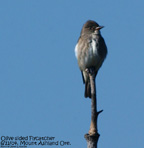
Olive-sided Flycatchers are often associated with burned forests, where open habitat, in combination with standing dead trees, creates abundant foraging opportunities.  Photo copyright James Livaudais.

Some of the birds that increased over the longer term were species like the Olive-sided Flycatcher, a species of conservation concern in the West. Immediately after the fire, this species was decreasing, but over time, it increased because areas that burned with high-severity resulted in standing dead trees where the flycatchers nest, and a shrub understory re-growth that provided the flycatchers with ample insect food. The House Wren, Lazuli Bunting, and Lesser Goldfinch had a similar story – they increased in areas that were burned and more so with increasing fire severity. The length of the study shed light on how a forest recovers from a mixed severity burn, detecting patterns that otherwise would have gone unnoticed.

“After more than 100 years of fire suppression, and now exacerbated by the effects of climate change, our forests may be at-risk of burning at uncharacteristically high severities. Today, forest managers are trying to remedy this problem with thinning and controlled fire, however, these common techniques sometimes fail to replicate the impact of a natural wildfire,” says Jaime Stephens, Science Director, Klamath Bird Observatory.

“The findings of this study can inform management actions, particularly when objectives relate to maintaining or improving ecosystem function” says Jena Volpe, Fire Ecologist, Bureau of Land Management. “Additionally, having long-term post-fire data, relevant to southwest Oregon, greatly improves our understanding of vegetation succession and fuel condition changes across our diverse landscape.”

So what does the study mean for forest management? The challenge of managing western forests in the face of climate change, drought, and a history of fire suppression is not easy. Results from this study show the importance of management techniques that mimic conditions created by a mixed-severity fire: a patchwork forest type, an abundance of snags, and allowing natural regeneration of shrubs. Using these techniques will make it more likely future fires will burn in a mosaic pattern as well, which will benefit birds and create healthy forests for years to come.

This study was funded by the Joint Fire Sciences Program, Rogue River-Siskiyou National Forest, Bureau of Land Management Medford District, and Secure Rural Schools and Community Self-Determination Act of 2000 Title II.

Klamath Bird Observatory (www.klamathbird.org) is fueled by partner-driven science programs. We use birds as indicators of the healthy and resilient ecosystems on which we all depend. Our science involves three integrated aspects: 1) long-term monitoring, 2) theoretical research, and 3) applied ecology. We bring our results to bear through science delivery involving partnership driven engagement in conservation planning, informing the critical decisions being made today that will have lasting influences on the health of our natural resources well into the future. Klamath Bird Observatory’s award-winning model was developed in the ruggedly beautiful and wildlife-rich Klamath-Siskiyou Bioregion. We now apply this model more broadly throughout the Pacific Northwest. Plus, our intensive professional education and international capacity building programs expand our influence into Mexico, Central and South America, and the Caribbean.

Click here for a PDF of this press release.

Click here for a press packet with a PDF of this press release and high resolution images.

##############

Recently published paper describes meaningful ecological units (i.e., Management Domains) for collaborative conservation in the Klamath Region

NAJ***SCIENCE BRIEF AND NEWS RELEASE – FOR IMMEDIATE RELEASE ***

August 14, 2015 – For Immediate Release

Contact: John Alexander, jda[AT]klamathbird.org, 541-890-7067

Patterns of plant, amphibian, mammal, and bird distribution have been used to identify ecological boundaries in the Klamath Region of southern Oregon and northern California, one of the most biophysically complex areas in North America. These patterns are described in a paper, recently published in the Natural Areas Journal, written by collaborators from the National Park Service, US Geological Survey, Klamath Bird Observatory, and other organizations. “This paper represents our first collaborative effort to link biogeography with protected areas management in the Klamath Region,” says the papers lead author, Daniel Sarr (formerly with the National Park Service and now working with the US Geological Survey). John Alexander, Klamath Bird Observatory’s Executive Director and a co-author on the paper added, “In the Klamath Region, natural resource managers are challenged with managing the complex array of environments that characterize the area. In this paper, we describe patterns that help delineate meaningful ecological units, or Management Domains, that are intended to advance collaborative natural resource management in the Region.”

The distributions of species described in the paper illustrate conceptual and spatial domains for natural areas management that provide an eco-regional framework for collaborative conservation. The paper describes a Maritime Management Domain in the western portion of the Region that is similar to other coastal areas. To the east, a Great Basin Domain that is similar to other Great Basin environments is also described. While conservation management approaches that have been tested in other areas of the west coast and Great Basin may be effectively applied in these two Domains, a third Eastern Klamath Management Domain, at the core of the Klamath Region, is more unique and presents novel management challenges. This third Domain has higher species richness and endemism than other environments in the western United States that are climatically similar, such as the southwest. Because the area is so unique, management approaches that have been successful in other areas may not be as easily applied in the Eastern Klamath Management Domain. Lead author Daniel Sarr explains further, “Because of its exceptional spatial complexity, it has not always been clear how management concepts and approaches developed in other areas of the West can best be used in the Klamath Region.”


However, the species that characterize the Eastern Klamath Domain may be the key to the conservation and management of natural areas in the Klamath Region. The Klamath Region will likely serve as an important refugia for a number of at-risk species that may become more threatened by climate change. Therefore management intended to help the Region’s unique array of native species persist into an uncertain future is becoming a priority. This paper presents an improved understanding of how such species are distributed across the region which, in combination with knowledge about the species’ habitat needs, can help inform design of the novel management approaches that may be needed in the Klamath Region.

Dr. Sarr concluded the following about these research results, “This new paper represents ongoing efforts to identify spatially explicit management domains and serves as a step forward. The work will undoubtedly be refined through ongoing observational science efforts being conducted by the Klamath Bird Observatory, National Park Service, and other regional partners.”

To access a copy of this new publication, Comparing Ecoregional Classifications for Natural Areas Management in the Klamath Region, USA in the Natural Areas Journal contact John Alexander (jda[AT]klamathbird.org, 541-890-7067) or click here.  Click here to view a PDF of this Science Brief and News Release.

———————————————-

About Klamath Bird Observatory

Klamath Bird Observatory, based in Ashland, Oregon, advances bird and habitat conservation through science, education, and partnerships. Klamath Bird Observatory is fueled by partner-driven science programs. We use birds as indicators of the healthy and resilient ecosystems on which we all depend. Our science involves three integrated aspects: 1) long-term monitoring, 2) theoretical research, and 3) applied ecology. We bring our results to bear through science delivery involving partnership driven engagement in conservation planning, informing the critical decisions being made today that will have lasting influences on the health of our natural resources well into the future.

Klamath Bird Observatory’s award-winning model was developed in the ruggedly beautiful and wildlife-rich Klamath-Siskiyou Bioregion. We now apply this model more broadly throughout the Pacific Northwest. Plus, our intensive professional education and international capacity building programs expand our influence into Mexico, Central and South America, and the Caribbean.

#################

Study results represent the first published documentation of El Niño’s influence on the survival of a resident tropical landbird and suggest that mature, un-fragmented forests may offer refuge in a changing climate

Oecologia July 2015

*** SCIENCE BRIEF AND NEWS RELEASE ***

*** FOR IMMEDIATE RELEASE ***

June 23, 2015

Contact: Jared Wolfe, jdw[AT]klamathbird.org, 262-443-6866

Habitat alteration due to forest clearing and climate change threaten wildlife populations across the globe. To better understand the interacting effects of habitat degradation and climate on bird populations, researchers from the U.S. Forest Service Pacific Southwest Research Station (PSW), Klamath Bird Observatory, and Costa Rica Bird Observatories spent 12 years studying the White-collared Manakin, a fruit-eating tropical bird, in mature and young forests along the Caribbean coast of Costa Rica. During the study, several El Niño and La Niña events—cycles of warm and cold ocean temperatures that influence air temperature and precipitation—resulted in very marked dry and wet annual conditions that allowed researchers to measure differences in manakin survival relative to climatic shifts. Results were recently published as the cover article in the journal Oecologia July 2015 edition.

In young tropical forests, researchers found dramatic decreases in manakins’ survival during dry weather associated with El Niño. Researchers believe that, due to a sparser canopy and their fragmented nature, the young forests were more susceptible to understory drying that reduced fruit production. Conversely, manakins’ survival rates were higher during wet years associated with La Niña events in these young forests where increased moisture and sun exposure likely led to an abundance of fruit resources. In mature forests, researchers observed very stable manakin survival rates regardless of climatic shifts, suggesting a relatively constant abundance of fruit resources.

“The complex structure of mature forest is thought to serve as a climatic refuge, buffering fruiting plants from climatic changes resulting in stable manakin survival,” says Jared Wolfe, a postdoctoral researcher with PSW and Klamath Bird Observatory and the study’s lead author. “Climatic refuges, such as mature tropical forests, may be important for many resident tropical bird species faced with the decreasing availability of mature forests coupled with increases in the severity of El Niño-associated dryness.”

These study results represent the first published documentation of El Niño’s influence on the survival of a resident tropical landbird. Researchers believe that variation in manakin survival between forest types provides insight into the sensitivity of certain species to habitat alteration. “From a management perspective, understanding how climatic events affect biodiversity is critical for the development of science-based conservation strategies,” says Pablo Elizondo, the Costa Rica Bird Observatories’ executive director and co-author of the study.

This publication represents an ongoing collaboration between Klamath Bird Observatory, the US Forest Service Pacific Southwest Research Station and International Programs, and the Costa Rica Bird Observatories.

To view the Oecologia paper click here.

Click here to view a pdf of this science brief and news release.

#################

Collaborative Partnerships and Data Sharing Result in Novel Approach for Better Conservation Planning

*** SCIENCE BRIEF AND NEWS RELEASE – FOR IMMEDIATE RELEASE ***

June 17, 2015

Contact: John Alexander, jda [AT] klamathbird.org, 541-201-0866 x1#

A recent study published in the journal Conservation Biology makes a strong case for a new approach to conservation planning that uses much more robust data sets in order to better protect birds, plants, and animals. The concept is fairly simple, but won’t work unless scientists can agree to share data across studies.

“Right now, we primarily only use presence and absence data for species when conservation planning for large landscapes. Much of this is due to the cost and time of collecting more comprehensive data,” said the study’s lead author, Sam Veloz, climate adaptation group leader at Point Blue Conservation Science. “We can do a much better job of conservation planning if we include data on individual species richness, not just whether they are present.”

To illustrate this point, a research collaboration including authors from Point Blue, American Bird Conservancy, and Klamath Bird Observatory encouraged partners to make their detailed bird observation data accessible through the Avian Knowledge Network.  Members of the Oregon/Washington Partners in Flight bird conservation community rallied to the call and over 900,000 new bird observations from 23 different studies were contributed to the Avian Knowledge Network through the Avian Knowledge Northwest node.  These data were then combined with bird data from the California Avian Data Center and used to develop both presence/absence species distribution models and density models covering coastal Northern California, Oregon and Washington for 26 species of land birds representing four different habitat types.  These models are freely available as part of the Pacific Northwest Climate Change Avian Vulnerability Tool available at Avian Knowledge Northwest.

To demonstrate the value of this large and detailed dataset, the Point Blue, American Bird Conservancy, and Klamath Bird Observatory researchers mapped conservation priority areas based on both the presence/absence and density models and compared the estimated population size protected in priority areas mapped using each method. “As expected, we found that the prioritizations based on count data protected more individuals of each species than the prioritizations based on presence/absence data in the areas of highest conservation priority,” Veloz said.

Veloz sees the main challenge is getting scientists from across the conservation spectrum to share their high-quality count data of individual species, no matter the study size, so planners can have as broad a dataset as possible when drawing up conservation plans. “This study shows the value of researchers sharing their data. We can combine and recycle data from multiple studies, and re-use it to answer larger conservation questions,” Veloz said. “If we all worked together to share data, we could better prioritize and protect important habitat.”

This study was funded by the North Pacific Landscape Conservation Cooperative.

To access this paper click here:

ConBi Paper

Full citation: Veloz, S., Salas, L., Altman, B., Alexander, J., Jongsomjit, D., Elliott, N., Ballard, G. 2015. Improving effectiveness of systematic conservation planning with density data. Conservation Biology. http://onlinelibrary.wiley.com/doi/10.1111/cobi.12499/abstract.

This news release adapted from Point Blue Conservation Science June 10, 2015 Press Release.