Oak Obligate Breeding Birds Response to Restoration: 2025 Field Season and What’s to Come
Oak ecosystems are some of the richest and most diverse wild spaces in the Pacific Northwest, providing habitats for a wide array of plants and wildlife. However, widespread losses of these important ecosystems have led to declines in many species that are reliant on oak habitats. Nearly half of the 49 bird species associated with oak habitats have experienced population declines in the Pacific Northwest. Within Southern Oregon, the Klamath Siskiyou Oak Network is working to promote the restoration and conservation of oak habitats. As these vital habitats are restored, research on how species respond to restoration can help build an understanding of how to better protect plants and wildlife for many years to come.
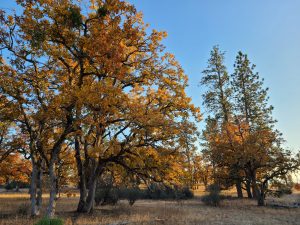 Klamath Bird Observatory and Cal Poly Humboldt Applied Avian Ecology Lab have partnered up to study the response of oak-obligate breeding birds to oak restoration efforts in the Rogue Valley of Oregon, and to understand what drives local population trends. We have selected three species that require oak habitat, Oak Titmouse, White-breasted Nuthatch (Slender-billed subspecies), and Ash-throated Flycatcher, to study in the California black oak and Oregon white oak woodlands at Table Rocks Management Area. We will assess various demographic metrics (nesting density, nest success, and number of fledglings produced) and vegetation structure in relation to restoration in an effort to understand how birds are doing in restored vs. unrestored oak areas. This study will provide essential information on avian responses to restoration and help inform and improve future management efforts.
Beginning of the Season:
The crew started off the season with nest searching for the three focal species across each of 20 field plots. Oak Titmouse, White-breasted Nuthatch, and Ash-throated Flycatcher pairs were found and followed from a distance as we attempted to locate their nests and estimate the number of pairs on each site. These species are all secondary cavity nesters, meaning that they are reliant on preexisting cavities, often excavated by woodpeckers or formed from natural decay, that frequently occur in large, mature oak trees. We found nests for each by noting which cavities pairs seemed interested in, such as the White-breasted Nuthatch pictured below, or watching them bring bits of grass, moss, or feathers to a cavity.
Middle of the Season:
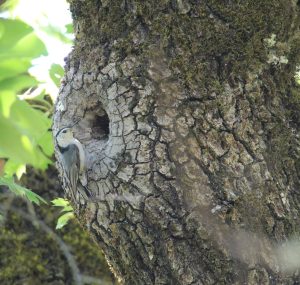
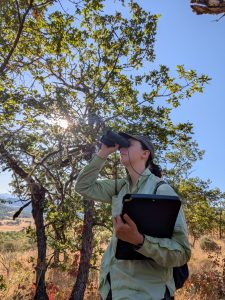
Pictured: A White-breasted Nuthatch checking out a cavity and Samantha Webb, Graduate Student in Cal Poly Humboldt Applied Avian Ecology Lab watching for breeding behaviors.
As we started to move further into the breeding season, we continued nest searching by watching out for adults bringing food back to their nests, as the Oak Titmouse is doing in the picture below. We also began to monitor the contents of all the nests that we had found. Using a tiny camera on a flexible pipe, we were able to peep into the nest cavity and count the number of nestlings, as well as estimate their age based on their size and feather development.
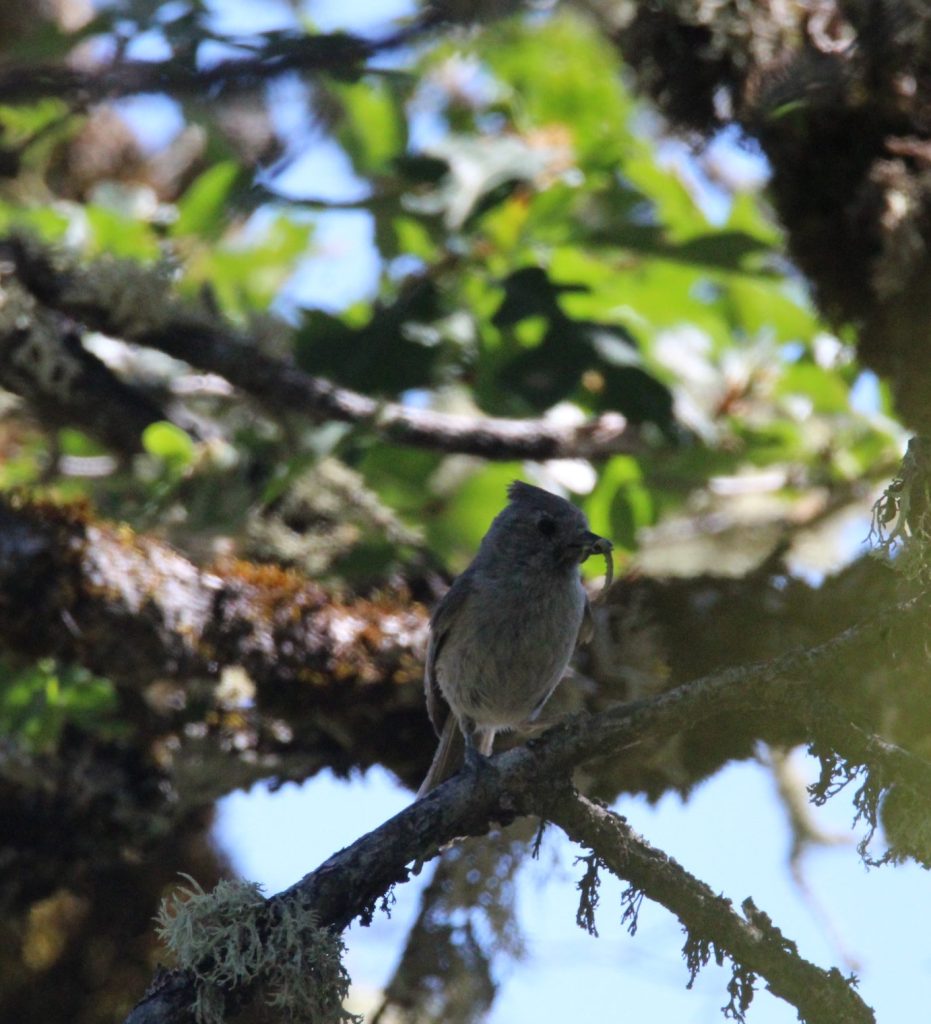
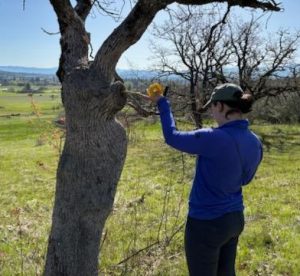
Pictured: Oak Titmouse bringing a caterpillar back to its nest and Samantha checking the contents of a nest using a flexible snake camera.
End of Season:
As the nestlings got bigger and more feathered (see the Ash-throated Flycatcher nestling below!), we got final counts of the number of nestlings in each nest to determine how many individuals would fledge. Once a nest had successfully fledged, we began vegetation surveys around the nest and its surrounding territory. We took measurements of vegetation cover, stand density, composition of different plant species, and average dbh (diameter at breast height) of oak tree stands.
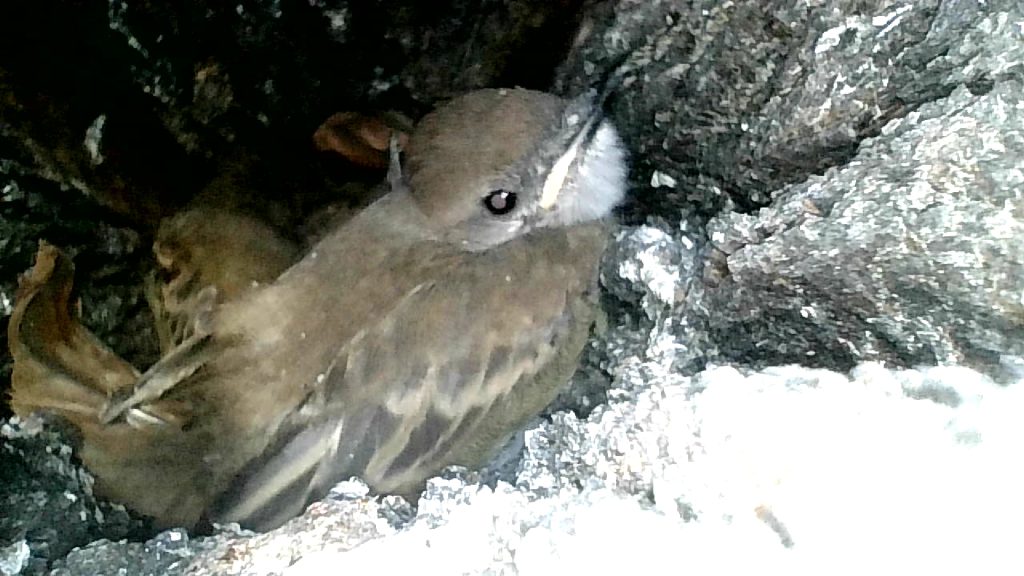
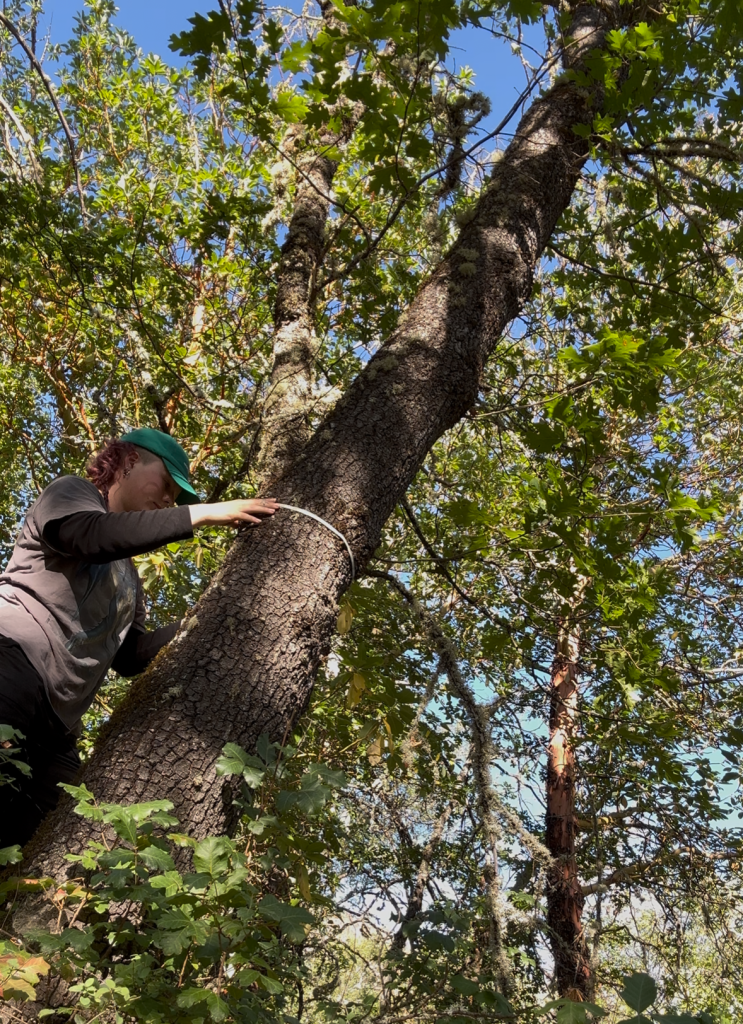
Pictured: Ash-throated Flycatcher nestling right before it fledged, picture taken inside the nest using a snake camera. Olive Smith, Cal Poly Humboldt Undergraduate Student Intern taking the diameter of a California black oak.
End of Season Wrap Up and Early Outcomes:
As the season came to a close, we finished data entry, and Graduate Student Samantha Webb is now hard at work, beginning to look at early results. This season, we found a total of 65 nests, including 31 Oak Titmouse, 21 Ash-throated Flycatcher, and 13 White-breasted Nuthatch nests. We also completed 260 vegetation surveys, four survey plots per nest. We plan to relate the density of nests, the number of successful nests, and the number of fledglings produced to these vegetation characteristics to understand how restoration-associated changes in vegetation influence reproductive outputs for these species.
Thanks to the gracious support from our funders, this project has been extended to include a second field season! We are extremely excited to continue to monitor these species’ nests, as well as add age class and body condition metrics to dive deeper into oak obligate bird responses to oak restoration. Stay tuned for next year!
Meet the Crew:
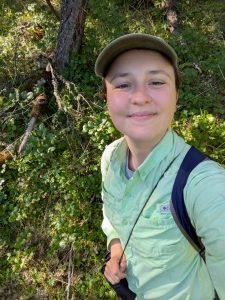
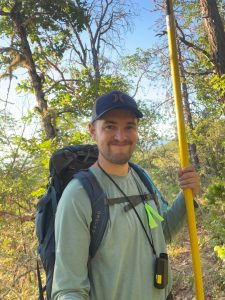
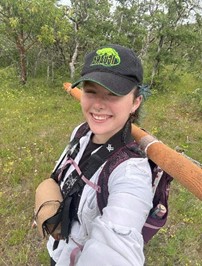
From left to right: Graduate Student Samantha Webb, Field Technician Adam Clayton, and Student Intern Olive Smith.
Our work and this essential research would not be possible without grant support. Thank you to the Bureau of Land Management, Greenfield-Hartline Habitat Conservation Fund, Oregon Birding Association, Oregon Wildlife Foundation, Oregon Conservation and Recreation Fund, Wilson Ornithological Society Jed Burtt Undergraduate Mentoring Grant, Conservation Unlimited Alumni Association, and Western Field Ornithologists for supporting this research.