
Tag: Klamath-Siskiyou Oak Network

Free Publication Informs Oak Habitat Conservation on Private Lands

*** NEWS RELEASE — FOR IMMEDIATE RELEASE ***

October 12, 2015

Contact: Jaime Stephens, jlh@klamathbird.org, (541) 944-2890 or
John Alexander, jda@klamathbird.org, (541) 890-7076

Oak Guide on Private Lands Cover Image (72ppi 5x6)

A document authored by Klamath Bird Observatory and Lomakatsi Restoration Project provides guidance for private landowners interested in implementing oak habitat restoration on their land. The document, entitled Restoring Oak Habitats in Southern Oregon and Northern California: A Guide for Private Landowners, emerged from a collaborative project involving a suite of private and public conservation partners, including the Bureau of Land Management (Medford District), US Fish and Wildlife Service’s Partners for Fish and Wildlife Program, Natural Resources Conservation Service, Klamath Basin Audubon Society, Oregon State University, American Bird Conservancy, and Klamath Siskiyou Oak Network.

Historically oaks were widespread throughout the valleys and foothills of Oregon and California. However, the arrival of Europeans to the region in the mid-1800s marked the beginning of a period of decline for oak habitats and their associated wildlife. Many oak woodlands were converted for agricultural uses or urban development, and decades of fire suppression during the latter half of the 20th century has allowed less fire-resistant yet faster growing tree species, such as Douglas-fir, to encroach upon and displace oaks. Now, the majority of remaining oak habitats occur on private lands. Private landowners are thus presented with an opportunity to restore healthy, wildlife-rich oak ecosystems to the landscape and thereby leave a valuable legacy for future generations.

The new landowner guide focuses on conservation practices for Oregon white oak and California black oak habitats. The document begins with an overview of the importance and history of oak habitats and then provides life history information for the oak species of the region. The guide next provides detailed oak restoration guidelines for achieving desired conditions in oak stands, such as diverse habitat structures, large oak trees, and the presence of snags, downed wood native shrubs and perennial grasses. The guide also includes supplemental resources for private landowners, including a list of organizations that will assist with private lands restoration as well as step-by-step instructions for monitoring birds to track the return of native wildlife following oak restoration activities.

This accessible, attractive, and informative guide is available for free download on the Klamath Bird Observatory website (click here). Funding for this project came from the Medford District of the Bureau of Land Management, a Toyota TogetherGreen grant managed by Klamath Basin Audubon Society, and the Rural Schools and Community Development Act.

######################

Klamath Bird Observatory, based in Ashland, Oregon,  is a scientific non-profit organization that achieves bird conservation in the Pacific Northwest and throughout the migratory ranges of the birds of our region. We developed our award-winning conservation model in the ruggedly beautiful and wildlife-rich Klamath-Siskiyou Bioregion of southern Oregon and northern California, and we now apply this model more broadly to care for our shared birds throughout their annual cycles. Emphasizing high caliber science and the role of birds as indicators of the health of the land, we specialize in cost-effective bird monitoring and research projects that improve natural resource management. Also, recognizing that conservation occurs across many fronts, we nurture a conservation ethic in our communities through our outreach and educational programs.
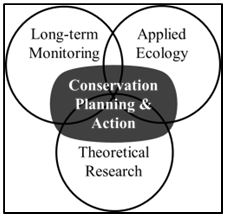
Klamath Bird Observatory’s Conservation Model

Klamath Bird Observatory’s collaborative conservation planning approach is fueled with results from partner-driven science programs. These science programs use birds as indicators of the healthy and resilient ecosystems on which we all depend. The science involves three coordinated aspects:

3 sceice tiers

  1. Long-term monitoring that provides information about broad-scaled changes in the condition of our world;
  2. More in-depth theoretical research about how natural and human influences affect our land, air, and water; and
  3. Applied ecology projects that directly address priority natural resource management challenges.

We bring results from our integrated science program to bear through an education and science delivery approach involving partner-driven engagement in conservation planning. With science, we are informing critical decisions being made today that will have lasting influences into the future.

Klamath Bird Observatory Science-based Conservation:
Local, Regional, and International

Klamath Bird Observatory’s award-winning conservation model is applied at local, regional, and international scales.

3 scales

  1. We developed our model locally in the ruggedly beautiful and wildlife-rich Klamath-Siskiyou Bioregion of northern California and southern Oregon where we maintain intensive science and conservation planning efforts.
  2. We now provide scientific resources and decision support across the Pacific Northwest region through the Avian Knowledge Northwest node of the Avian Knowledge Network.
  3. Our intensive professional education and international capacity building programs expand our influence into Mexico, Central and South America, and the Caribbean where we actively support partners who are applying our model through a network of locally driven programs aimed at protecting birds throughout their breeding, migration, and wintering ranges.

Klamath Bird Observatory Conservation Model Applied:
Restoration for Oak Woodland Birds and Their Habitats

Our work to advance oak woodland conservation provides a classic example of this model in action. Our science provides:

  1. A clear sign that oak woodland bird populations are in decline;
  2. Information about their habitat needs and the possible influence of climate change on their health and distribution; and
  3. Results that tell us what kind of management actions benefit these species.

Armed with this information we identify conservation priorities and projects to benefit oak related species in Canada, the United States, Mexico, and Central America. We offer specific guidance for broad-scaled restoration of oak habitats in the Pacific Northwest. In northern California and southern Oregon we are partnering to design, fund, and evaluate specific restoration projects on public and private lands, ensuring on-the-ground benefits to birds. Our leadership in the Klamath-Siskiyou Oak Network (KSON) cultivates partnerships that have resulted in over $6 million for on-the-ground restoration that is driven by our conservation planning approach. KSON oak conservation programs have been highlighted in the last two national State of the Birds reports and received the U.S. Department of Interior Partners in Conservation Award.

The Klamath Bird Observatory
Advancing bird and habitat conservation through
science, education, and partnerships

Science Guides Private Lands Conservation

oak_foreground

This article is the seventh installment in the series Achieving Partners in Flight Strategic Goals and Objectives.


Klamath Bird Observatory is working with local restoration partners to integrate Partners in Flight priorities and objectives into private lands restoration programs.  The Central Umpqua Mid Klamath Oak Habitat Conservation Project, funded by the NRCS Cooperative Conservation Partnership Initiative (CCPI) and the US Fish and Wildlife Service Partners for Fish and Wildlife Program, is a landscape-scale effort to restore oak woodlands on private lands in southern Oregon and northern California.  As a part of this project 15 public and private partners leveraged over $3.8 million to restore 2,000 acres of Oregon white oak habitat.


Lomakatsi Restoration Project and Klamath Bird Observatory are using objectives from regional Partners in Flight (PIF) conservation plans to guide the restoration.  Habitat objectives for Oak Titmouse, Acorn Woodpecker, Black-throated Gray Warbler, and other oak woodland species are providing details for management prescriptions designed to create oak woodland habitat mosaics, restore native perennial grasses, and reintroduce natural fire regimes whenever possible.  Bird monitoring is being integrated into habitat monitoring efforts to assess the effectiveness of restoration based on PIF population objectives. This unique collaboration received the 2012 Department of Interior Partners in Conservation Award.


Download the Partners in Flight Conservation Brief for this project by clicking here. Also see the 2013 State of the Birds Report on Private Lands that highlighted this collaborative oak restoration project in the section on western forest conservation.

2013 State of the Birds Report: Bird Populations Depend on Private Lands

A new national report released today by the North American Bird Conservation Initiative, and contributed to by local science-based non-profit Klamath Bird Observatory, highlights the considerable extent to which native bird populations in the United States depend on private lands. Significantly, the 2013 State of the Birds Report on Private Lands also demonstrates that conservation action on private lands is not just for the birds; landowners and the general public benefit from conservation actions that result in cleaner air and water and more resilient and productive landscapes.


Throughout our nation, some two million ranchers and farmers and about 10 million woodland owners look after 1.43 billion acres, or roughly 60% of the land area of the United States. These private lands support more than 300 forest-breeding bird species, and several grassland birds have more than 90% of their distribution on private lands. Waterfowl also depend heavily on private lands. Innovative conservation partnerships are changing the face of private lands conservation as private landowners see real benefits and neighbors follow suit through so-called “contagious conservation.” 

In our own backyard, Klamath Bird Observatory is partnering with Lomakatsi Restoration Project, US Fish and Wildlife Service Partners for Fish and Wildlife Program, Natural Resources Conservation Service, and private landowners, and using birds to guide restoration on 2,000 acres of private oak woodlands in southern Oregon and northern California. This unique collaboration—the Central Umpqua-Mid Klamath Oak Conservation Project—received the 2012 Department of Interior Partners in Conservation Award and is restoring one of the West Coast’s most imperiled and biologically rich habitats, benefiting Oak Titmouse, Acorn Woodpecker, and Black-throated Gray Warbler. (To learn more about oaks ecosystems in the Pacific Northwest, download Klamath Bird Observatory and American Bird Conservancy’s Land Manager’s Guide to Bird Habitat and Populations in Oak Ecosystems of the Pacific Northwest, as well as the supplemental guide that features species accounts.)


Klamath Bird Observatory advances bird and habitat conservation in the Klamath-Siskiyou Bioregion and beyond, and has contributed to the high-profile annual State of the Birds reports since the initial report in 2009. Klamath Bird Observatory believes that bird conservation is relevant to every American because the same landscapes that support diverse and abundant bird communities also provide vital services to humans.


John Alexander and Jaime Stephens from Klamath Bird Observatory, and Marko Bey from Lomakatsi Restoration Project, will discuss the 2013 State of the Birds Report on Private Lands on Jefferson Public Radio’s news and information program Jefferson Exchange on Wednesday, July 10th from 9:00am until 10:00am. Tune-in to learn more about what birds tell us about the state of the environment; how these local organizations are working with private landowners to provide benefits for landowners, wildlife, and society; and how America’s famous land ethic—articulated by Aldo Leopold—is being realized.

Access this Press Release in PDF Format by clicking here.  To listen to the Jefferson Exchange interview with John Alexander, Jaime Stephens, and Marko Bey by clicking here.