
Scaling Oak and Prairie Conservation from Local to Regional Success
Executive Summary
 The Klamath Siskiyou Oak Network (KSON) is leading a model conservation effort to protect and restore oak ecosystems in southern Oregon and northern California. Through its Strategic Conservation Action Plan, KSON is addressing threats including conifer encroachment, fire exclusion, and habitat loss with science-based, collaborative strategies grounded in Traditional Ecological Knowledge. With past and current investments of $22 million, their work is on track to restore over 10,350 acres by 2030.
Building on this local success, the Prairie, Oaks, and People Investment Strategy coordinates nine partnership initiatives across the Pacific Northwest. This regional strategy, led by the Pacific Northwest Oak Alliance, aims to protect and restore over 70,000 additional acres, further the recovery of Tipping Point species like the Lewis’s Woodpecker and Oregon Vesper Sparrow, and strengthen Tribal and rural community leadership. Together, KSON’s local leadership and the regional investment strategy represent a scalable, shovel-ready blueprint for oak and prairie conservation.
This tiered approach—local action scaling to regional impact—was recently recognized nationally in the 2025 State of the Birds Report. The report highlights the Prairie, Oaks, and People partnerships, including KSON, as a leading example of how targeted, science-driven conservation can reverse the steep declines facing grassland and oak woodland birds.
Now is the time to build on this momentum. Bold investment, sustained collaboration, and strategic scaling of proven models, such as KSON’s, can secure a future where oak and prairie ecosystems—and the communities and species that depend on them—thrive once again.
Building from Local to Regional Success: How Oak and Prairie Conservation in the Klamath-Siskiyou is Scaling Up Across the Pacific Northwest
The Klamath Siskiyou Oak Network (KSON) is a long-standing partnership working to conserve oak ecosystems in southern Oregon and northern California—a globally significant biodiversity hotspot. KSON’s 2020 Strategic Conservation Action Plan outlines a 30-year vision to restore four distinct oak habitat types: oak savanna, oak woodland, oak chaparral, and oak-conifer forests.

KSON’s plan identifies the primary threats degrading these ecosystems—conifer encroachment, fire exclusion, agricultural conversion, and invasive species—and prioritizes a set of enabling and implementation strategies to address them. These strategies emphasize:
- Increasing restoration efforts, such as prescribed fire and conifer thinning;
- Integrating Traditional Ecological Knowledge and partnering with Tribal Nations;
- Building technical capacity for restoration across public and private lands;
- Monitoring progress through clear indicators tied to ecological attributes like native understory diversity, oak regeneration, and bird community composition.
KSON’s work is grounded in the principle that conservation must be collaborative and culturally informed. Since its formation in 2010, KSON has restored over 6,500 acres, investing more than $7.5 million, through close collaboration with Tribes, local agencies, NGOs, and landowners. Now, following the Strategic Conservation Action Plan, KSON is leveraging an additional $14.5 million to restore 3,850 acres on private and BLM-managed lands through the Upper Rogue Oak Initiative.
The local success of KSON offers more than a blueprint for oak conservation—it serves as the southern anchor of a much larger regional effort.

Scaling Up: The Prairie, Oaks, and People Investment Strategy
Recognizing that local success stories, such as KSON’s, must be replicated across a broader geography to achieve a meaningful and lasting impact, the Prairie, Oaks, and People Investment Strategy was developed to coordinate and scale conservation efforts across the Pacific Northwest’s oak and prairie landscapes.
Led by the Pacific Northwest Oak Alliance, this regional strategy unites nine partnership initiatives—each operating in different parts of Washington, Oregon, and British Columbia—into a shared framework for action. Together, these groups aim to protect 10,200 acres, restore 60,000 acres, recover key species, and build Tribal and community capacity over the next five years.

The strategy calls for a $304 million investment focused on four main pillars:
- Land Protection: Securing remaining high-value oak and prairie habitats through easements and acquisitions;
- Habitat Restoration: Using ecocultural fire, invasive species management, and oak recruitment to rebuild habitat resilience;
- Species Recovery: Focusing on priority bird species like Lewis’s Woodpecker and Oregon Vesper Sparrow—both recognized as Tipping Point species requiring immediate action;
- Capacity Building: Expanding the workforce, tools, and funding needed to sustain long-term conservation success, particularly through Tribal leadership and local stewardship.
Importantly, the Prairie, Oaks, and People strategy connects ecological restoration with rural resilience, promoting sustainable grazing, native seed production, cultural renewal, and climate adaptation as co-benefits of habitat work.
The Klamath Siskiyou Oak Network’s local plan is nested within—and critical to—the success of this broader regional vision. Lessons learned and methods proven in the KSON geography are informing restoration priorities, investment strategies, and monitoring frameworks across the entire Pacific Northwest oak and prairie range.
National Recognition: Highlighted in the 2025 State of the Birds Report
The impact of this tiered, integrated approach has not gone unnoticed. The 2025 State of the Birds Report—the nation’s leading assessment of bird population health—specifically showcases the Klamath Siskiyou Oak Network and the Prairie, Oaks, and People strategy as outstanding examples of conservation success.
 The report underscores the crisis facing oak- and prairie-dependent bird species. Western forest birds have declined by 11%, grassland birds by 43%, and oak-woodland specialists like the Lewis’s Woodpecker and Oregon Vesper Sparrow are among those identified as “Tipping Point” species, having lost more than half their populations over the past 50 years.
Yet amid these sobering trends, the State of the Birds spotlights KSON’s and the broader Pacific Northwest Oak Alliance’s work as proof that proactive, coordinated, science-based action can reverse declines. Restoration of oak and prairie systems is already helping to stabilize and increase populations of several plant and insect species. These efforts are also enhancing climate resilience, rural economic vitality, and cultural renewal.
This national recognition validates the approach: start with place-based, community-led action (like KSON’s work), scale it through regional coordination (as in Prairie, Oaks, and People), and secure broader conservation gains with tangible, measurable outcomes.
Call to Action
 The intersection of the Klamath Siskiyou Oak Network Strategic Plan and the Prairie, Oaks, and People Investment Strategy—now recognized in the 2025 State of the Birds Report—shows the power of building conservation from the ground up and scaling it strategically across landscapes.
By aligning local success with regional coordination and national attention, we can restore the Pacific Northwest’s oak and prairie ecosystems, support imperiled bird species, strengthen communities, and build climate resilience for future generations.
The work ahead demands bold investment, sustained partnership, and a shared commitment to scaling what works.
Together, we can ensure that oak and prairie ecosystems—and the diverse birds, wildlife, and cultures they sustain—thrive once again.
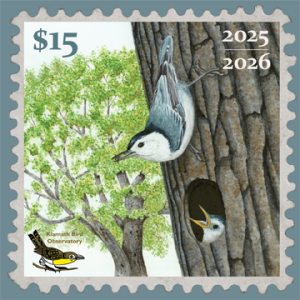
You can help support this important work by making a donation or purchasing the 2025-2026 Conservation Stamp Set.
