
Author: KBO

Year of the Bird’s June Call to Action: Skip the Plastic!

It is June in the Year of the Bird and this month’s Call to Action is to Skip the Plastic. Our use of plastics has far out-stripped our ability and motivation to keep it out of natural environments. The accumulation of discarded plastic is both plain to see and nearly invisible almost everywhere, creating an acute problem for all life on Earth.

But we are in a time of change—there is real traction around this issue at the individual level and among policy makers and industry leaders. Innovators are offering solutions to municipal waste management and creative ways to repurpose trash.

This month, Year of the Bird spotlights this issue because of the acute challenge it presents to bird conservation. From the National Geographic Society’s Call to Action …

Why is plastic a problem for birds?
• The threat to birds is severe: 90 percent of seabirds eat plastic and virtually every one will be consuming it by 2050. Flesh-footed Shearwaters eat more plastic as a proportion of their body mass than any other marine animal.
• The problem is growing: Scientists have been tracking plastic ingestion by seabirds for decades. In 1960, plastic was found in the stomachs of fewer than five percent, but by 1980, it had jumped to 80 percent. World plastic production has increased exponentially from 2.3 million tons in 1950 to 162 million in 1993 to 448 million by 2015!

How can we all help solve the problem?
• Shop with reusable bags. Shoppers in the United States use almost one plastic bag per resident per day. Shoppers in Denmark use an average of four per year.
• Recycle—this old idea is still far from common place. The United States recycles just 9 percent of its plastic trash.
• Properly dispose of your own trash and pick up litter when you can. Join or organize a community park or beach clean-up.
• Do not purchase plastic bottles and start carrying a reusable straw. Bottles take 450 years to biodegrade.
• Avoid products with plastic packaging and buy in bulk. The largest market for plastics today is packaging materials—most of it never gets recycled or incinerated.

To learn more about this tragic problem and what we can all do to help solve it …

CLICK HERE to view the National Geographic Society’s Nearly Every Seabird on Earth Is Eating Plastic article.

CLICK HERE to view the National Geographic Society’s Reducing Plastic as a Family Is Easy article.

CLICK HERE to view the National Audubon Society’s Eight Easy Ways to Reduce Your Plastic Waste article.

CLICK HERE to view some of Photographer Mandy Barker’s artwork using discarded plastic in the ocean, on beaches, and inside seabirds.

If you haven’t already heard, 2018 is Year of the Bird! The National Geographic Society is celebrating the centenary of the Migratory Bird Treaty Act with a year-long celebration of birds. Dozens of Year of the Bird partners, including Klamath Bird Observatory, are coordinating Year of the Bird activities.

CLICK HERE to learn more about the Year of the Bird at the National Geographic Society’s website.
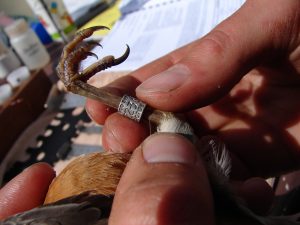
KBO’s Fundamentals of Songbird Banding Workshop is filling up—register soon!

Just a few spots are still open for KBO’s Fundamentals of Songbird Banding Workshop August 6-10, 2018 at our Upper Klamath Field Station. This is a North American Banding Council-approved training session with NABC-based content and NABC-certified Trainer instructors. All registration fees go directly to funding our long-term monitoring and banding training program. Registration closes July 20, 2018.

Participants will receive training in bird safety, bird handling, mist net use and maintenance, data collection, bird identification, bird banding, and sexing and ageing techniques through both hands-on instruction while capturing birds and numerous seminars. The workshop program has been developed for people with little or no bird handling and banding experience, although is also appropriate for those with intermediate skills for which it will build upon their existing skills and knowledge.

The registration fee is $1,600 per person and is non-refundable. Registration includes all meals (including beverages and snacks) beginning with dinner Monday August 6 and ending with lunch Friday August 10. Space is available for free tent camping at KBO’s rustic Upper Klamath Field Station. There is lodging available nearby at several Rocky Point area resorts and lodges (all with rooms and/or cabins as well as RV and tent camping) and a few options on Airbnb (search Rocky Point or Klamath Falls, Oregon). A little further away are Running Y Ranch Resort (about 20 minute drive) and hotels in Klamath Falls (about 40 minutes).

For more information about the workshop (including workshop agenda, nearby lodging info) and to register click here. Registration will closes July 20, 2018.

Come for a top-notch banding learning experience and help keep our long-running monitoring and training program going. For more information and answers to any questions please contact Bob Frey at bif<AT>klamathbird.org.

CLICK HERE for more information about bird banding training opportunity.

2018 BioBlitz! Citizen Scientist Bird Count in the Cascade-Siskiyou National Monument

“More than 85 people fanned out across the Cascade-Siskiyou National Monument early
Saturday May 26 on a mission to count birds. In small groups, birding experts and citizen-scientists
began at daybreak surveying 11 different sites within the monument.

A total of 112 bird species were identified during this BioBlitz, including both resident and
migrating species. “It’s remarkable that during one eight-hour period nearly half the number of
species that have been reported during the entire month of May in all of Jackson and Siskiyou
counties were recorded,” says Klamath Bird Observatory Executive Director John Alexander.

A BioBlitz is a communal citizen-scientist effort to record as many species as possible within a
designated time and place. “A BioBlitz is a great way to engage the community and connect them to their monument while generating useful data for science and conservation. They are also an excuse for naturalists, scientists, and curious members of the public to get together in the great outdoors for fun and to contribute something meaningful.” explained Howard Hunter, a board member for the Friends of the Monument.” -From the Friends of the Cascades-Siskiyou National Monument’s BioBlitz Press Release.

Read more in the Friends of the Cascades-Siskiyou National Monument’s BioBlitz Press Release.

Only Two Spots Left For Our Malheur Birding Expedition!

MALHEUR BIRDING EXPEDITION—led by Harry Fuller

Our always popular Malheur birding trip is scheduled for June 2nd-5th, 2018! This five-day and four-night eastern Oregon birding expedition will begin with birding from Ashland to Summer Lake, exploring surrounding wildlife areas, and stay at the Summer Lake Lodge. On the second day we will arrive at the Malheur National Wildlife Refuge—birding this special area the next three days with accommodations at Crystal Crane Hot Springs those three nights. Bring your swim suit as we will study the night sky from the warmth of the hot spring pool in the evenings (optional of course). One night we will have dinner at the famous Diamond Hotel. Dinners will include tallies of our birds for the day.

Some of the species we hope to see: Cinnamon Teal, Trumpeter Swan, White-faced Ibis, Sandhill Crane, Ferruginous and Swainson’s hawks, Bald and Golden eagles, nesting Long-billed Curlew, Wilson’s Phalarope and Wilson’s Snipe, Franklin’s Gull, Black Tern, Prairie Falcon, Great Horned and Barn owls, Common Nighthawk, Loggerhead Shrike, Eastern Kingbird, Gray Flycatcher, Say’s Phoebe, Black-billed Magpie, Rock and Canyon wrens, Sage Thrasher, Mountain Bluebird, Sagebrush and Brewer’s sparrows, and Yellow-headed Blackbird. We have seen as many as 142 species on this trip in the past.

Cost of the trip is $575 which includes modest accommodations, dinners, transportation (a small van will be available plus there will be room in vehicles), and the expert guiding of birding extraordinaire and bird guidebook author Harry Fuller. $300 of this will be a tax deductible contribution to the Klamath Bird Observatory so not only will you have a fantastic adventure in a very special part of the world, you’ll contribute to bird and habitat conservation efforts.

Participants will need to bring breakfast and lunches. Sign up by contacting Shannon Rio at shannonrio@aol.com or call her at 541-840-4655.

KBO Research Documents Short-Distance Migrations of Breeding and Molting Birds

Birds in the western United States time their breeding and molting (annual replacement of feathers) behaviors with seasonally abundant food resources. Understanding how birds move across the western landscape to acquire the food they need to successfully breed and molt represent critical pieces of information for wildlife managers.

To measure bird movements in the western United States, researchers from Klamath Bird Observatory and U.S. Forest Service Pacific Southwest Research Station have been capturing and marking birds throughout northern California and southern Oregon. These data have now been used to analyze movements of breeding and molting birds to better understand the habitat requirements of multiple species throughout their annual life-cycle.

“After the breeding season, many species were found to move away from their breeding grounds before they began molting” says Jared Wolfe, co-author and KBO research associate. “My graduate student leading this research, Andrew Wiegardt, and I, in addition to the KBO scientific team, believe that dry, late-summer environments prevent many birds from remaining on their breeding grounds late in the season. To find the insect and fruit-rich habitats necessary to molt, many birds left their breeding territories and made small-scale movements to environments with more food, such as wet meadows and riparian forest”.

Results from this recent research highlight that most migratory species are reliant on multiple locations and habitats in northern California and southern Oregon to breed and molt prior to fall migration. For long-distance migrants, such as Wilson’s Warblers, these different locations used for breeding and molting often occurred on an altitudinal gradient where birds tended to breed in lower elevations during the spring, and then moved upslope to molt at higher elevations late in the summer.

The findings of this study were published in the March 2017 issue of Journal of Field Ornithology and the October 2017 issue of Ecology and Evolution.

***

KBO Research Associate Dr. Jared Wolfe received his BS and MS from Humboldt State University. He completed his PhD at Louisiana State University studying landscape demography of Amazonian birds. Dr. Wolfe is a science advisor for Costa Rica Bird Observatories, co-founder of the Louisiana Bird Observatory, North American Banding Council certified trainer and current board member serving as a trainer-at-large, and a permitted master bander in the USA and Brazil. He regularly coordinates bird monitoring and statistical workshops in the USA, Costa Rica, Peru and Brazil. Dr. Wolfe is an Assistant Professor at Michigan Tech University.

Jared’s affiliation with KBO has been long and fruitful, resulting in multiple scientific publications focused on migratory and resident bird demography as well as the influence of climate on migratory bird condition, molt patterns and novel ageing systems for tropical birds.

Year of the Bird in May – It’s a Global Big Day!

It’s May in the Year of the Bird and our call to action is Global Big Day! Saturday May 5th is the day people all over the world will be watching birds and putting them on the world map via eBird.

What to do: Look for birds and report what you find at eBird.org in this exciting 24-hour quest to collectively record as many bird species as possible across the world.

How to do it: Watch birds on May 5th –any time from midnight to midnight in your local time zone. It’s that simple. You don’t need to be a bird expert, or go out all day long.
• Get an eBird account if you don’t already have one: eBird is a worldwide bird checklist program used by hundreds of thousands of birders. It’s what allows us to compile everyone’s sightings into a single massive Global Big Day list—while at the same time collecting the data for scientists to use to better understand birds. It’s free. Log your sightings on the eBird website or download the eBird app, for maximum ease-of-use.
• Watch the sightings roll in: During the day, keep an eye on how the lists are growing in different parts of the world. Follow along with sightings from more than 150 countries, including the Cornell Lab’s Team Sapsucker in Colombia, Honduras, and California. Stats will be updated in real-time on our Global Big Day page.

Pro Birder Tips for Big Day Success:
• Explore eBird Hotspots near you.
• Put your birding plans on the worldwide Global Big Day map.
• Get together with friends and set a goal for your birding—most unusual species? Biggest flock? All the species in your favorite family? The possibilities are endless.
• Take photos and add them to your checklist—they might end up on the Global Big Day page!

Why do it?
• Put your birds on the map! Your sightings become part of a global snapshot that helps track the numbers, health, and movements of birds for scientists and conservationists.
• It helps other birders: your data feeds migration forecasts, species checklists, and hotspot maps that are free for all.
• 20,000 bird watchers around the world will be on a 24-hour birding binge; count yourself in their ranks.
• In 2017, bird watchers recorded an incredible 65% of all the bird species on the planet. Can we set a new record?

CLICK HERE to learn more about Global Big Day and eBird.

And don’t miss World Migratory Bird Day! There are 1,200 events happening around the world in 200 cities on Saturday May 12, including two KBO is part of—Rogue Valley Bird Day and the Global Migratory Bird Day Birdwatching Field Trip in Shasta Valley Wildlife Area.

CLICK HERE to view the Rogue Valley Bird Day 2018 flyer.

CLICK HERE to view the Shasta Valley Birdwatching Field Trip 2018 flyer.

Of course the invaluable citizen science wonder that is eBird is bigger than Global Big Day—watch the birds any day and let your observations add to our body of knowledge, empowering bird conservation science through eBird. Every bird counts so count all your birds!

Big News for World Migratory Bird Day!

World Migratory Bird Day (WMBD) in the Year of the Bird is May 12, 2018—a day to celebrate the amazing annual migrations of the birds who know no borders. The day is also for raising awareness of conservation challenges that these world travelers face and what we can do to help.

This WMBD (formerly known as International Migratory Bird Day) is a special one for Klamath Bird Observatory. We are part of a group being recognized for its collaborative achievements in migratory bird conservation. KBO will also be part of two local WMBD celebrations—Rogue Valley Bird Day in Ashland and the WMBD Birdwatching Field Trip at Shasta Valley Wildlife Area near Montague, California.

It has just been announced that the Western Hummingbird Partnership has been given the U.S. Forest Service’s 2018 Wings Across the Americas award. This is a prestigious award that recognizes outstanding achievements in the conservation of migratory birds—to be presented at a special World Migratory Bird Day ceremony in Washington, D.C. this Tuesday May 1st. KBO’s Executive Director Dr. John Alexander will join other members of the Western Hummingbird Partnership Advisory Group in receiving the award.

KBO will join many local partners for the City of Ashland Department of Parks and Recreation’s Rogue Valley Bird Day Saturday May 12th at North Mountain Park from 8 am to 1200 pm. KBO biologists will demonstrate mist netting and banding songbirds as a part of the festivities. We will also join A World Migratory Bird Day Birdwatching Field Trip at Shasta Valley Wildlife Area starting at 7:30 am. This event is sponsored by Klamath National Forest.

CLICK HERE to view the Rogue Valley Bird Day 2018 flyer.

CLICK HERE to view the Shasta Valley Birdwatching Field Trip 2018 flyer.

Join us for World Migratory Bird Day!


The Western Hummingbird Partnership addresses a critical need in hummingbird conservation—engaging researchers, educators, and governmental and non-governmental groups in collaborative science and education. Key partners include Klamath Bird Observatory, Environment for the Americas, Point Blue Conservation Science, University of Guadalajara, and U.S. Forest Service. Since 2006, the Partnership has contributed to projects in biosphere reserves, botanic gardens, and national forests and has provided funding in support of projects where western hummingbirds nest, stop during their migrations, and winter.

MALHEUR IN JUNE BIRDING EXPEDITION—led by Harry Fuller

Announcing our always popular Malheur birding trip scheduled for June 2nd-5th, 2018!

This five-day and four-night eastern Oregon birding expedition will begin with birding from Ashland to Summer Lake, explore surrounding wildlife areas, and stay at the Summer Lake Lodge. On the second day we will arrive at the Malheur National Wildlife Refuge—birding this special area the next three days with accommodations at Crystal Crane Hot Springs those three nights. Bring your swim suit as we will study the night sky from the warmth of the hot spring pool in the evenings (optional of course). One night we will have dinner at the famous Diamond Hotel. Dinners will include tallies of our birds for the day.

Some of the species we hope to see: Cinnamon Teal, Trumpeter Swan, White-faced Ibis, Sandhill Crane, Ferruginous and Swainson’s hawks, Bald and Golden eagles, nesting Long-billed Curlew, Wilson’s Phalarope and Wilson’s Snipe, Franklin’s Gull, Black Tern, Prairie Falcon, Great Horned and Barn owls, Common Nighthawk, Loggerhead Shrike, Eastern Kingbird, Gray Flycatcher, Say’s Phoebe, Black-billed Magpie, Rock and Canyon wrens, Sage Thrasher, Mountain Bluebird, Sagebrush and Brewer’s sparrows, and Yellow-headed Blackbird. We have seen as many as 142 species on this trip in the past.

Cost of the trip is $575 which includes modest accommodations, dinners, transportation (a small van will be available plus there will be room in vehicles), and the expert guiding of birding extraordinaire and bird guidebook author Harry Fuller. $300 of this will be a tax deductible contribution to the Klamath Bird Observatory so not only will you have a fantastic adventure in a very special part of the world, you’ll contribute to bird and habitat conservation efforts.

Participants will need to bring breakfast and lunches. Sign up by contacting Shannon Rio at shannonrio@aol.com or call her at 541-840-4655.

A New Citizen Science Opportunity

Klamath Bird Observatory and The Selberg Institute recently completed a successful year-long citizen science project on the beautiful Sampson Creek Preserve just east of Ashland. This work would not have been completed without a group of dedicated citizen scientists who spent many mornings birding the property. During the year 119 species were detected on 105 eBird checklists, with Acorn Woodpecker being the most detected species. Though this project is coming to a close we are excited to announce a new citizen science project on the Grizzly Peak Preserve.

This project offers something for all birders and outdoor enthusiasts. Participants will have the choice to bird on fairly flat terrain walking less than two miles through meadows and oak trees or for more adventurous birders to explore off-trail along a gradient of different habitats. The project will take place on a large parcel of private property along the slopes of Grizzly Peak, with survey locations starting just minutes outside of the city of Ashland boundary and continuing up Shale City road. The Preserve is in the foothills of the Cascades and holds a variety of oak habitats as well as coniferous forests and riparian woodlands. The Preserve is a terrific spot for birding and will give the public a unique opportunity to visit and bird in diverse habitats managed for conservation.

Citizen Scientists will be trained on a simple protocol to learn how to collect data, and the opportunity for monthly surveys will continue throughout the year. If you enjoy looking for owls, you are in luck as well. This project will also include two guided night surveys to inventory the local owl population. Participation in surveys will include some walking and/or hiking, recording all birds observed by sight and/or sound, and entering and submitting your findings into eBird Northwest. With this project we aim to complete a robust inventory for the bird species on the Grizzly Peak Preserve by harnessing the power of Citizen Scientists to collect robust data throughout the breeding, migratory, and winter seasons.

As spring migration is underway surveys are starting at the Grizzly Peak Preserve, if you are interested in participating or would like more information please contact KBO Biologist Ellie Armstrong at eea@klamathbird.org.