It’s August in the Year of the Bird and this month’s call to action is to go bird watching on your public lands … and eBirding is a great way to do it! To help us all with this eBird Northwest has published Year of the Bird: August Action with information about using eBird and finding public lands near you.
If you haven’t already heard, 2018 is Year of the Bird! The National Geographic Society is celebrating the centenary of the Migratory Bird Treaty Act with a year-long celebration of birds. Dozens of Year of the Bird partners, including Klamath Bird Observatory, are coordinating Year of the Bird activities.
KBO hosted the 2018 Fundamentals of Bird Banding Workshop at our Upper Klamath Lake Field Station August 6-10. Biologists from near and far—California, Idaho, Nevada, Oregon, Nicaragua, the Marianas Islands, and Spain (!)—joined KBO’s banding team for four days of interactive hands-on instruction and afternoon seminars. Topics ranged from safe mist net use in capturing small birds to age- and sex-determination techniques in this the North American Banding Council-sanctioned training workshop. The fantastic group took the “work” out of workshop and made it all a lot of fun! Most of the group now bring new knowledge and sharpened skills to their ongoing banding projects.
Proceeds from the workshop help fund our long-term monitoring and student volunteer internship programs. KBO has hosted bird banding workshops at our Upper Klamath Lake Field Station for over 20 years—an important component of our professional education program.
The accomplishments of Klamath Bird Observatory’s Science Director Jaime Stephens have been recognized by the international bird conservation consortium Partners in Flight (PIF)—presenting her with its prestigious Leadership in Conservation Award. The Leadership Award honors an individual or group that demonstrates outstanding guidance and direction that contributes, or has contributed, to advancing Partners in Flight conservation efforts. Jaime accepted the award at the North American Wildlife & Natural Resources Conference in Virginia earlier this year.
In nominating Jaime, colleague Barb Bresson, Regional Avian Program Manager with the US Forest Service and 2013 Leadership Awardee, stated “Jaime exemplifies excellence in leadership as KBO’s Science Director supervising and mentoring a team of incredibly effective, passionate, and productive biologists while also actively engaging and taking on leadership roles in PIF and within other conservation focused initiatives.”
Since her start with KBO in 2002, Jaime has placed her indelible stamp on bird conservation at all scales, local to international. It is the breadth and depth of her accomplishments that prompted this recognition. As Science Director, she directs the science program at KBO, conducting and publishing her own work on bird conservation but collaborates extensively with colleagues on other science. She has been instrumental in driving the discussion on bird data management nationally, has led the way for bird conservation partnerships across the west to greater and more permanent conservation action, and continues to seek new opportunities to improve and align bird conservation. Her effectiveness stems from her steadfast belief in a data-driven approach to bird conservation science, and from her infectious enthusiasm, optimism, and engaging leadership style which brings together partners from similar and disparate groups.
Jaime served as Chair of the Western Working Group of Partners in Flight (WWG) for three years (2012-2015). During her tenure, the WWG established new internal policies of governance lending long-term stability to the organization, expanded the Group’s reach and diversity of participants, and advanced new conservation initiatives which continue today. This is consistent with her steady and reasoned leadership style which engenders trust and credibility. When Jaime talks, people listen. Despite having rotated out of the Chair position, Jaime continues to lend her expertise and experience to the WWG, and continues her strong and positive influence on the direction of the WWG’s conservation initiatives in the west, from Mexico to Canada.
Jaime embodies the mission of Partners in Flight—to advance full life-cycle conservation of landbirds in the Americas via sound science, integrated conservation partnerships, habitat delivery on public and private lands, and targeted citizen outreach. Her accomplishments hold significance. Please join us in congratulations to Jaime for this well-deserved recognition.
California Condors are not only the largest avian scavenger in North America, they are a species of cultural significance for the Yurok Tribe of Northern California. Yurok ancestral territory is in the heart of the historical range of California Condors and the tribe has been working with Klamath Bird Observatory research associate, Dr. Jared Wolfe, to assess the feasibility of condor reintroduction. The researchers used Turkey Vultures and Common Ravens as surrogate species to determine the amount of lead and mercury avian scavengers are exposed to in Humboldt and Del Norte counties of Northern California. Their results were published by the American Ornithological Society’s Condor: Ornithological Applications journal as “Feasibility of California Condor recovery in northern California, USA: Contaminants in Surrogate Turkey Vultures and Common Ravens”.
“Lead poisoning is the number one threat to condor recovery thus far and an understanding of exposure in local avian scavengers is crucial prior to establishment of new release sites” says Chris West, Senior Wildlife Biologist with the Yurok Tribe. “Condors ingest lead from scavenging animals or offal from animals that were shot with lead bullets. In addition to lead, mercury exposure from feeding on washed-up marine mammals may represent an additional, at this time unassessed, threat that reintroduced condors must contend with.”
Here are three important highlights from the study:
• Although lead levels detected in ravens were lower than levels detected from a similar study conducted in Wyoming, there was still a significant increase in lead exposure during the hunting season in Humboldt and Del Norte counties.
• Lead detected in vultures and ravens increased with distance from coastline suggesting a connection to the greater availability of inland public lands accessible to hunters in Humboldt and Del Norte counties where the study occurred.
• Mercury detected in vultures and ravens decreased with distance from the coastline indicating that scavenging birds are likely exposed to mercury from marine resources rather than at inland locations in Humboldt and Del Norte counties.
“These results highlight some of the conservation challenges associated with condor reintroduction” says Dr. Wolfe. “Recognizing these challenges, the Yurok Tribe has done an excellent job working with the hunting community to switch from lead ammunition to condor friendly non-lead ammunition.”
The researchers believe that continued outreach to hunting communities will limit the amount of lead on the landscape for all avian scavengers and, crucially, for future populations of condors. Hunter outreach and a California-wide ban on the use of lead ammunition for hunting scheduled to go into effect in 2019 may present new opportunities for California Condor recovery in Yurok ancestral territory and beyond.
John Alexander, KBO co-founder and Executive Director is featured in the current edition of the Point Blue Quarterly. Conservation Frontman: John Alexander, Klamath Bird Observatory describes the energy, focus, and passion John brings to the enduring Point Blue—KBO partnership. Point Blue leaders and John himself share perspectives of their collaborations that are making a positive difference.
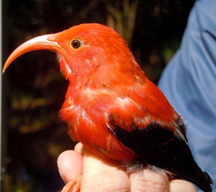
Native Hawaiian birds are renowned for their beauty and unique evolutionary history, where numerous species rely on native plants for food in the form of nectar and fruit. Many of these important native plants that provision food for birds rely on climatic cues – such as rain and temperature – to time their flowering and fruiting activity. Understanding how birds respond to climatically-induced changes in their food web represents an important step towards predicting the effects of climate change on vulnerable wildlife species.
To better understand these complex relationships, Klamath Bird Observatory research associate, Dr. Jared Wolfe, and KBO research advisor, Dr. C. John Ralph, used data collected from the Big Island of Hawaii to measure long-term relationships between changes in climate, fruit and flower production, and the timing of breeding and molting in native and non-native birds. Their results were recently published in the scientific journal Ecology in a paper titled “Bottom-up Processes Influence the Demography and Life-cycle Phenology of Hawaiian Bird Communities”.
“Flower and fruit abundance at our study site were strongly affected by seasonal changes in rain, which had cascading effects on the timing of important lifecycle events of birds, such as breeding seasonality”. says lead author Wolfe. “Our results suggest that changes in climate can cascade up the food chain and strongly affect wildlife at higher trophic levels.”
Results from the analysis suggest that three native birds that commonly feed on nectar, the ʻiʻiwi, ʻapapane and Hawaiʻi ʻamakihi, all timed their breeding season with the availability of ʻōhiʻa lehua flowers, which in-turn, used heavy rains to time flowering activity.
“Our project is one of the first from Hawaii to combine long-term climate, plant phenology and bird monitoring data to disentangle these complex trophic relationships” says co-author Ralph. “These types of studies are rare because they rely on long-term and labor-intensive field work. But, findings from long-term studies such as this one are critically important because they provide insights into how changes in climate might affect native Hawaiian birds.”
Crater Lake National Park and Klamath Bird Observatory are presenting a bird ecology program series this summer and into the fall. The Park Ranger-led programs feature a visit to KBO’s bird monitoring station within Crater Lake National Park.
The programs are on Thursday mornings, but not every Thursday—please check the Crater Lake National Park series flyer for scheduled dates. Don’t miss this opportunity to visit KBO’s biologists in the field, see the birds they are studying up close, guided by an expert Park Ranger!
KBO is also offering public visits to another of our bird monitoring station in the Upper Klamath Lake area by arrangement. Email Bob Frey for more information.
The Year of the Bird July call to action is to take a child into nature. Even with school out, summer is a great time to learn! Spending time with children outside, and discovering new things, may spark a lifelong passion and value of environmental stewardship—plus it’s an easy and cheap venue for fun!
Today, children are spending less and less time outdoors. A Nature Conservancy poll showed that only about 10% of kids spend time outside every day. Studies have shown that bird watching and other outdoor recreation activity can help kids build creativity, attention span, confidence, and happier and healthier lives.
If you haven’t already heard, 2018 is Year of the Bird! The National Geographic Society is celebrating the centenary of the Migratory Bird Treaty Act with a year-long celebration of birds. Dozens of Year of the Bird partners, including Klamath Bird Observatory, are coordinating Year of the Bird activities.
Klamath Bird Observatory will again join in the festivities at the Oregon Country Fair (OCF) this year. The uniquely-Oregon arts, crafts, music, and well-being fair takes place July 13-15.
KBO shares an information booth with the Master Gardeners in Community Village—look for the Yellow-breasted Chats! We will lead a morning Birds of the Fair walk and we are a joyful participant in the OCF StewardShip Program as a Passport Station. OCF’s StewardShip Program celebrates the Fair’s sustainability and philanthropy. Check out the full line up of workshops and performances at the Stewardship in Xavanadu and to participate in the OCF Scavenger Hunt. Stop by our booth to learn about the Birds of the Fair and get your StewardShip Passport Book stamped!
The Oregon Country Fair (OCF) creates events and experiences that nourish the spirit, explore living artfully and authentically on earth, and transform culture in magical, joyous and healthy ways.
The OCF is an annual three-day festival offering the finest in entertainment, hand-made crafts, delectable food and information sharing. The Fair takes place in Veneta, Oregon, about 15 miles west of Eugene. The Fair takes place in a wooded setting with its own water and communication systems, security team, recycling service, and much, much more. We enjoy a mutually cooperative relationship with our neighbors and a solid niche in the Veneta community. Started in 1969 as a benefit for an alternative school, the OCF has a rich and varied history of alternative arts and performance promotion, educational opportunities, land stewardship and philanthropy.
Crater Lake National Park and Klamath Bird Observatory will present a bird ecology program series this summer and into the fall. These park ranger-led programs will feature a visit to KBO’s bird monitoring station within Crater Lake National Park.
The programs will be on Thursdays, but not every Thursday—please check the Crater Lake bird banding visit flyer for scheduled dates. The first program is next Thursday June 28!
Don’t miss this opportunity to visit KBO’s biologists in the field, see the birds they are studying up close—guided by an expert park ranger.
KBO is also offering public visits to another of our bird monitoring station in the Upper Klamath Lake area by arrangement. Email Bob Frey for more information.
 If you haven’t already heard, 2018 is Year of the Bird! The National Geographic Society is celebrating the centenary of the Migratory Bird Treaty Act with a year-long celebration of birds. Dozens of Year of the Bird partners, including Klamath Bird Observatory, are coordinating Year of the Bird activities.