SCIENCE BRIEF: New data synthesis helps guide western forest restoration for birds, water, and communities
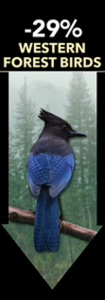
More than half of the forest-dependent birds in the western United States are declining—one of the broadest declines of any bird habitat group. At the same time, many western forests have shifted away from their historical conditions, contributing to habitat loss, reduced forest diversity, greater risk of severe wildfire, and diminished freshwater supplies. Conservation partners have access to extensive information about these challenges, but putting those data together in a way that supports coordinated action remains difficult.
A new peer-reviewed paper, “Western forests data synthesis: birds, climate, forests, and water,” describes an analysis that Klamath Bird Observatory worked on with Pacific Birds Habitat Joint Venture and the Intermountain West Joint Venture. Migratory Bird Joint Ventures work to support habitat-focused conservation of landbirds, shorebirds, waterbirds, and game birds across North America and are well positioned to support Western forests and their surrounding communities. The analysis brings multiple sources of information together to help conservation partnerships identify where forest restoration could provide the greatest benefits for birds, forests, watersheds, and people. This paper was co-authored by the Klamath Bird Observatory and Pacific Birds Habitat Joint Venture.
The paper, “Western forests data synthesis: birds, climate, forests, and water,” is part of the Avian Conservation and Ecology special feature, “Partners in Flight International Science Committee: Migratory Bird Conservation Tools and Applications.” Like the broader feature, this paper highlights the role of collaborative applied science in helping the bird conservation community move from concern to measurable action.
National bird conservation lists provide an important foundation for action, but they do not always capture species whose conservation needs are most apparent at a regional scale. To address this gap, the research team used the Partners in Flight Avian Conservation Assessment Database to develop regional lists of priority western forest birds. The study examined four Bird Conservation Regions covering much of the western United States within the Pacific Birds and Intermountain West Joint Ventures.
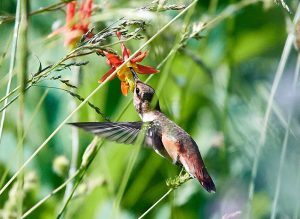
The researchers identified 66 unique priority western forest bird species, with 31 to 41 priority species identified in each Bird Conservation Region. Most were classified as needing Management Attention or long-term Planning and Responsibility. Each region also included two to four species requiring more urgent action through Critical Recovery or Immediate Management.
The team then mapped where these priority species occur across 542 mid-sized watersheds. They combined the bird information with data describing forest types, the degree to which current vegetation differs from historical conditions, priority areas for restoring bird habitat and increasing carbon storage, projected climate risk, watershed condition, and land ownership.
Together, these layers help answer important conservation-planning questions, such as where multiple priority bird species occur together. Where have forests departed most from historical conditions? Where could restoration improve bird habitat while also supporting carbon storage, watershed health, and community resilience? And which land managers and conservation partners need to work together to make restoration possible?
For example, areas where many priority bird species overlap with forests that have substantially departed from historical conditions may offer important restoration opportunities. Adding information about climate risk and watershed condition can further identify places where restoration could support forest resilience, water resources, and communities. Land-ownership information helps clarify where cross-boundary partnerships will be essential.
The authors emphasize that this synthesis is a broad-scale starting point rather than a site-level restoration plan. Local knowledge, ecological monitoring, Indigenous leadership and priorities, social science, and input from the people who live and work in these landscapes will all be necessary when developing specific conservation projects.
The study is already informing conservation delivery across the West. Using results from this analysis and other emerging information highlighting declining forest birds, the Intermountain West Joint Venture recently launched an implementation plan that is focused on improving forest habitat for birds and other wildlife, reducing wildfire risk, and supporting forest-dependent communities. Pacific Birds Habitat Joint Venture is also building on its established oak and prairie conservation program to address challenges facing conifer and mixed-forest ecosystems from California to Alaska.
The regional priority lists are also supporting Pacific Birds and KBO’s work to connect the broader Prairie, Oaks, and People Investment Strategy with the needs of imperiled oak- and prairie-associated birds in the Pacific Northwest. By combining regional priorities with local monitoring and conservation plans, partners can better identify which species need attention and where investments can make a measurable difference.
This research reflects KBO’s approach to conservation science: using birds as indicators of ecological conditions, bringing together existing science and data, and delivering that information to partnerships working on the ground. By connecting bird conservation with forest health, wildfire resilience, climate adaptation, and clean water, the study provides a practical framework for advancing restoration that benefits both birds and people.
Recommended citation
Gillespie, C. R., M. L. McClure, J. D. Alexander, S. T. Evans-Peters, M. N. Iglecia, and J. L. Stephens. 2026. Western forests data synthesis: birds, climate, forests, and water. Avian Conservation and Ecology 21(2):2.
Funding for this work was provided by Pacific Birds Habitat Joint Venture and Intermountain West Joint Venture through a cooperative agreement with Klamath Bird Observatory facilitated by Ducks Unlimited.
As the special features are published, they can be found on the Avian Conservation & Ecology website.