Author: KBO

National “State of the Birds” Report Assesses Health of Birds and Environment in the USA

In the West, Forest Bird Populations Are Down, but Klamath Bird Observatory and Partners Offer Solutions
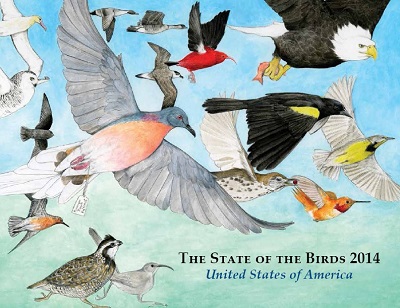
2014_sotb_coverThe nation’s top bird science and conservation groups have come together to publish State of the Birds 2014—the most comprehensive examination of long-term trend data for US birds ever conducted. The authors call the results unsettling, an alarming declaration that comes as we stand upon the 100th anniversary of the extinction of the Passenger Pigeon—once one of the most abundant birds in the world. The good news is that the report reveals that in areas where strong investments in science and conservation have been made, bird populations are recovering.


Klamath Bird Observatory, a science-based non-profit organization that achieves bird conservation in the Pacific Northwest, has contributed to this year’s State of the Birds report through staff participation on the report’s Science and Communications Teams. Klamath Bird Observatory has offered a notable perspective to these annual reports starting with the initial report published in 2009; primarily, we inform content relating to long-term bird monitoring, conservation opportunities, and western forest birds.


The national report finds bird populations declining across several key habitats. Most birds of concern fall into the following categories: seabirds, shorebirds, Neotropical migrants, Hawaiian forest birds, and birds using aridlands, grasslands, forests, or coastal habitats. Aridland birds appear to have the steepest population declines of any group of birds by habitat type; there has been a 46 percent loss of these birds since 1968, according to long-term monitoring data on a suite of 17 bird species that breed in desert, sagebrush, and chaparral habitats in the West.


Western forest bird population declines are also of concern; their populations are down 20 percent since 1968. Both early successional species (such as Rufous Hummingbird and Wilson’s Warbler) and mature forest species (such as Vaux’s Swfit and Cassin’s Finch) are declining, while species dependent on oak woodlands (such as Oak Titmouse) are showing the steepest declines. Despite these general trends, there are examples of dedicated partnerships turning the conservation tide; in fact, two conservation success stories from our region are highlighted in the State of the Birds 2014 report. These are:

  • Klamath Siskiyou Oak Network partners recently restored 6,000 acres in southern Oregon and northern California, benefiting oak dependent birds. This collaboration is an excellent example of a public-private partnership, involving Klamath Bird Observatory, Lomakatsi Restoration Project, US Fish and Wildlife Service’s Partners for Fish and Wildlife Program, Natural Resources Conservation Service, Bureau of Land Management (BLM), and others.
  • At the Cascade Siskiyou National Monument, bird monitoring data collected by Klamath Bird Observatory helped guide improved grazing management on 52,000 acres of public lands. This success story involved Klamath Bird Observatory collaborating with BLM, Geos Institute, Oregon State University, the US Geological Services Co-op Unit, and others to implement a comprehensive study that informed management decisions that are likely benefitting many resident and migratory birds that depend on its oak woodland habitats in the Monument.

The strongest finding in State of the Birds 2014 is simple: conservation works. For example, alarming declines in grassland bird populations have leveled off since 1990 due to significant investments in grassland bird conservation. Bald Eagles, Brown Pelicans, Peregrine Falcons—all species once headed the way of the Passenger Pigeon—are now abundant.


In the Pacific Northwest, Klamath Bird Observatory and partners are poised to advance bird conservation on public lands by participating in the management planning process with the two major landholding agencies in the region: the US Forest Service and the Bureau of Land Management. Klamath Bird Observatory offers expertise in the application of comprehensive datasets and a series of Decision Support Tools maintained within the environmental datacenter Avian Knowledge Northwest. The inclusion of bird monitoring and bird conservation science into large-scaled management planning will not only help address the conservation needs of western forest birds in the Pacific Northwest, it will help natural resource managers to better implement forest restoration priorities, resulting in healthier, more productive land and water for birds, other wildlife, and for us.


State of the Birds 2014 United States of America will be available online at http://www.StateoftheBirds.org.  The State of the Birds 2014 report release press conference will be broadcast live from the Smithsonian Castle in Washington, DC via a streaming webcast Tuesday September 9th from 10:00 to 11:00 am Eastern (7:00 to 8:00 am Pacific); tune in at http://www.smithsonianscience.org.


Click here to access a PDF version of this Press Release.

A Sparrow with Two Possible Stories

By Brandon Breen, Klamath Bird Observatory Science Communications

sosp_bandedOn the morning of June 14th, 2014, Linda and Peter Kreisman noticed a Song Sparrow with a small metal band on its right leg. The bird was seen at Ashland Pond, a small water body on the northern edge of town and adjacent to Bear Creek, a tributary of the Rogue River. Peter was able to capture the photograph shown on the right, which reveals a few of the identifying numbers etched into the metal band. Once Linda and Peter returned home, they contacted KBO.

Robert Frey, KBO’s Banding Project Lead, took a look at the photo. The full band number was not visible, but from the digits that Robert could see he thought he might be able to narrow down the date when the bird was first captured and banded, to within a month or so, and possibly determine the location as well.

The busy field season kept Robert occupied for most of June and July, but once back in the office his detective work yielded results. Linda and Peter’s Song Sparrow has two possible stories.

Story One: The sparrow was banded on May 8th, 2012 at KBO’s long-term monitoring station along Bear Creek and behind the Willow Wind Community Learning Center in Ashland, Oregon. The full band number is 1641-01151.

Story Two: The sparrow was banded on May 12th, 2012 at North Mountain Park in Ashland, Oregon during a banding demonstration along Bear Creek for Rogue Valley Bird Day, a local celebration of International Migratory Bird Day. The full band number is 1641-01153.

In both cases, the Song Sparrows were males in breeding condition that had hatched in 2011 or earlier.

song_sparrow_map_marked

We know from past KBO data that several year-round resident songbird species, such as Bewick’s Wren, Black-capped Chickadee, Song Sparrow, and Spotted Towhee, move along Bear Creek following the seasons and available resources.

The Song Sparrow is perhaps the most familiar sparrow in the United States. They keep relatively low to the ground as they utilize grasses and shrubs for nesting and foraging, and feed on seeds, berries, and a variety of invertebrates. Song Sparrows are habitat generalists and they will inhabit numerous habitats containing low, dense thickets near wet or marshy areas.

Banding Outreach in the Fremont-Winema National Forest

BobKlamath Bird Observatory hosted an outreach event for professional partners on June 9th at our Upper Klamath Field Station’s Sevenmile Long-term Bird Monitoring and Banding Station in the Fremont-Winema National Forest. This picturesque research facility, a historic Forest Service Guard Station, is located on the northern outskirts of the Klamath Basin, nestled in a small clearing surrounded by shrubs, forest, and streamside habitats.

Such habitat diversity translates into avian diversity, and as our partners enjoyed pastries, spooned parfait, and sipped coffee at the start of the event, a variety of birds called from the surrounding vegetation, including Northern Flickers, Yellow Warblers, Western Tanagers, Pacific-slope Flycatchers, Song Sparrows, and an occasional chatty Belted Kingfisher.

Klamath Bird Observatory initiated this first annual Bird Banding Outreach Day to demonstrate the value of our long-term monitoring program to our professional partners who support the KBO programs that inform their natural resource management work on public lands.  KBO Executive Director John Alexander opened the event with an overview of the history of the Klamath Bird Observatory, focusing on our work in the Klamath Basin and our nearly 20 years of collaboration with the US Forest Service, Bureau of Land Management, and US Fish and Wildlife Service.  Then, Science Director Jaime Stephens provided a summary of our scientific programs, including a new study on the habitat preferences of Black-backed Woodpeckers in green, unburned forests.

KaitlinThe group, including US Forest Service professionals from the Fremont-Winema National Forest, then moved to a shaded picnic table near a copse of young aspen where biologists are set up to measure, band, and release songbirds that are being tracked as part of KBO’s long-term monitoring program. When we arrived, KBO intern Kaitlin Clark from Michigan was gently blowing on the head feathers of a Yellow Warbler to glean information about skull development that can help determine the bird’s age.

KBO Biologist and Banding Project Leader Robert Frey described the purpose and procedure of the banding program to our guests. In brief, bird banding is a method of bird monitoring that can be used to track the size and characteristics of a population over time. First, a bird is gently caught in a soft, fine net called a mist net. After being carefully removed by a biologist, a small aluminum band is placed around the bird’s leg like a bracelet. Engraved in the band is a unique number which will allow biologists to track the bird if it is recaptured. Additional data are collected (e.g., age, sex, weight, breeding condition) and then the bird is released to continue its daily activities.

The Klamath Bird Observatory banding program has numerous conservation applications. We learn whether birds are successfully breeding in an area—an indication of healthy habitat. We learn whether birds are surviving migration—information that can inform international conservation efforts. Re-sightings of banded birds give us specific locations related to migration routes and overwintering sites. More generally, we monitor birds because they tell us about the functioning of the environment as a whole, and this has important consequences for birds, other wildlife, and human communities.

GroupBefore concluding our morning, each of the banding interns—including Aracely Guzman from Mexico City, Alexis Diaz from Lima, Peru, and Chris Taft from Seattle, Washington—spoke about their interest in bird conservation and their professional development goals for their internship with KBO. One of the great contributions of the KBO banding program is the training of over 170 early-career conservation biologists who go on to advance conservation in the US and abroad where many of our breeding birds spend their winters.

Klamath Bird Observatory is grateful for our federal agency partners who enable and support the bird conservation work we do on public lands. Thanks to all of those who joined us for our first annual Bird Banding Outreach Day!

Support KBO through Amazon Smile and eScrip

present_shutterstockThere are now two new – and simple! – ways to support Klamath Bird Observatory while you shop. The first is Amazon.com’s charitable giving program called Amazon Smile. In this program, Amazon donates 0.5% of eligible purchases to the charitable organization of your choice. To participate in this program and donate to Klamath Bird Observatory whenever you shop on Amazon Smile, go to smile.amazon.com and select Klamath Bird Observatory as your charitable organization.

The second charitable giving program is eScrip. If you live in or near southern Oregon, you may register your credit, debit, and grocery loyalty cards with eScrip, and then a percentage of your purchases at participating merchants, such as Safeway and Market of Choice, will be donated to Klamath Bird Observatory. Click here to register with eScrip and name Klamath Bird Observatory as your charitable organization.

Mountain Bird Festival Receives Mindful Birding Award

TwoBirders_GrahamLewisKlamath Bird Observatory receives the world’s first Mindful Birding Award for its efforts to promote a Mindful Birding ethic, and the role of birdwatchers as significant conservation actors, through its inaugural Mountain Bird Festival that will be held in Ashland, Oregon from May 30th through June 1st, 2014.  The Mountain Bird Festival combines a celebration of the Klamath-Siskiyou Region’s spectacular mountain birds with the stewardship ethic needed to ensure thriving landscapes for humans and wildlife.

Mindful Birding recognizes that bird watching, by nature, is an outdoor activity that connects participants with nature through an appreciation of the magnificence of birds.  With this recognition of the inherent value of birding, the Mindful Birding ethic encourages bird watchers to be mindful toward wildlife, mindful to safety and other people, and mindful of their own birding experience. With such consciousness it is believed that bird watchers will carry a Mindful Birding ethic from the field into their everyday activities, becoming even stronger messengers for and supporters of conservation for birds and people.  The Morrissey Family Foundation issued this first Mindful Birding Award in recognition of Klamath Bird Observatory’s efforts to promote birding ethics and conservation through the Mountain Bird Festival.

The Mountain Bird Festival is a unique community conservation event that celebrates the globally outstanding Klamath Siskiyou Region, recognized for its abundance of different habitats and species.  The festival offers two days of field trips that will search for mountain bird specialties, such as White-headed Woodpecker, Mountain Quail, Calliope Hummingbird, and Great Gray Owl.  The festival also features a fine art auction, live music, local foods and beverages, cocktail parties, and stimulating evening presentations.  Klamath Bird Observatory will distribute specific Mindful Birding guidelines to festival attendees and provide training to field trip leaders, who will encourage Mindful Birding practices on field trips.

Klamath Bird Observatory is hosting the 2014 Mountain Bird Festival in partnership with the City of Ashland, the Ashland Chamber of Commerce, ScienceWorks Hands-On Museum, and many other organizations.

Click here to access a PDF of this press release.

Celebrating Birds in the Rogue Valley

John Alexander and Brandon Breen in the Jefferson Exchange studioKlamath Bird Observatory’s John Alexander and Brandon Breen were interviewed on Friday May 23rd in the Jefferson Public Radio studio for the Jefferson Exchange news and events program. John and Brandon discussed the history and role of the Klamath Bird Observatory and described the organization’s upcoming Mountain Bird Festival, which combines a celebration of mountain bird species with the commitment needed to ensure these birds – and the habitats they depend on – thrive into the future.

Click here to visit the Jefferson Exchange webpage about the interview.

Click here to listen to the full interview.

Birding Bonanza

bb_mailtribune_jaimeluschKlamath Bird Observatory’s inaugural Mountain Bird Festival received coverage through the article “Birding Bonanza” featured on the cover of the Outdoor Section of the Medford Mail Tribune on Friday May 23rd, 2014. The article describes one of the festival’s field trips that has a high likelihood of encountering the magnificent Great Gray Owl. The article also describes the conservation focus of the festival. KBO Executive Director John Alexander is quoted, “Birds are indicators of forest health and indicators of our well-being. Birds tell us a lot about what we can do better with our natural resources.” Festival participants, while birdwatching, will collect a wealth of information on the distributions and abundance of over 100 birds species during the 3-day festival. This information will be entered into eBird Northwest, a regional portal of the eBird program, and this information will provide knowledge that we can use to become better stewards.

Local Artists Shine at Mountain Bird Festival


SandhillTrio_KatrinaEliseMeister

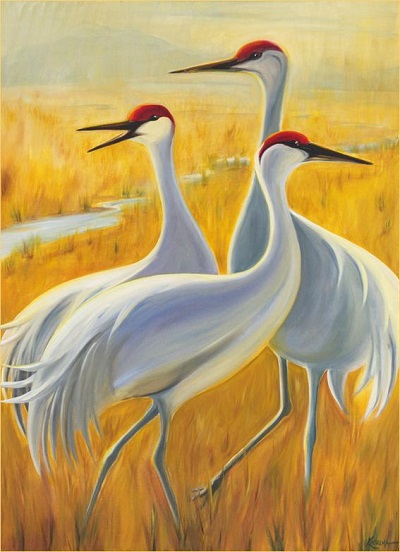
Fine art can be a powerful force for bird conservation. This notion will come to life at the upcoming Mountain Bird Festival through a Fine Art Auction featuring the impressive talent of our region’s artists. There will be 14 art submissions for auction, and bids can be placed on Friday May 30th from 5:00 – 9:00pm and on Saturday May 31st from 5:00 – 6:45pm at the festival’s headquarters: ScienceWorks Hands-On Museum (1500 E Main St, Ashland).

Bids can be placed by individuals who are registered for the festival, or by individuals who purchase a Federal Migratory Bird Hunting and Conservation Stamp and a Mountain Bird Conservation Science Stamp ($15 each, $30 in total) at the door to gain entry to the evening festivities, including art auction, no-host bar, and Saturday keynote presentations and music. Funds generated from stamp sales will directly support bird and habitat conservation.

To the right and below, we share a sample of the fine art that will be on display at the first-ever Mountain Bird Festival. The Mountain Bird Festival is a community conservation event hosted by Klamath Bird Observatory, in partnership with the City of Ashland, Ashland Chamber of Commerce, and ScienceWorks Hands-On Museum.

<img class=" wp-image-1793 " style="border: 2px solid black" src="https://klamathbird.org/wp-content/uploads/2014/05/EvenSong_JoanLBrown.jpeg" alt="EvenSong_JoanLBrown" width="500" height="250" title="Evensong by Joan L Brown, oil on canvas, 18 x 36"” />


RavenI_PamHaunschild


Flight_EvaThiemann

Bird Bio: Pacific Wren

pawrBy Ellie Armstrong, KBO Trinity River Field Technician

The Pacific Wren (Troglodytes pacificus) is North America’s smallest wren, measuring only about four inches from the beak to the tip of its tail. This wren has a rich rufous-brown body, pale legs, dark bill, and a pale eyebrow, and the most remarkable attribute, perhaps, is its joyous and beautifully complex song, which can be heard near streams in moist coniferous forests throughout the Pacific Northwest.

In 2010 the Pacific Wren officially became its own species, having been formerly grouped with the Winter Wren (T. hiemalis) and what is now recognized as the Eurasian Wren (T. troglodytes). The Winter Wren occurs primarily in the eastern US and Canada, and the Eurasian Wren occurs throughout Europe and into parts of Asia. The split of the Winter Wren into three species occurred as a result of years of research that revealed, among other findings, that the eastern and western US populations are genetically distinct and hybridization is rare where their ranges overlap. Analyses of songs have shown that the Pacific Wren has a distinct and rapid song comprised of up to 36 notes per second, whereas the song of the Winter Wren is significantly slower and more similar to the song of the Eurasian Wren.

The Pacific Wren associates closely with moist coniferous forests. Important breeding season habitat contains old-growth trees, fallen logs, and woody debris, and they tend to occur near rivers and streams in areas with low levels of habitat fragmentation. That said, the Pacific Wren can also occasionally be found in deciduous forests, at elevations over 3,500 meters above sea level, and even on cliff faces.

Pacific Wrens have been called “nook and cranny” nesters due to their creative and secretive placement of nests in cavities of wood, rocks, and other materials. When cavities are not available, males will build their nests inside clumps of moss on tree branches, underneath root masses of overturned trees, or under stream banks within their territories. Females choose one of the available nests and complete nest construction by adding a soft lining of feathers or hair.

Males sing complex songs throughout the year; these songs last 5-10 seconds and in some populations the average male has a repertoire of 21 song variations. To attract a mate, a male may perch above a female and sing to her while fluttering his wings and moving his tail from side to side. A male will also show an interested female the nests he has built by flying through the territory and becoming louder and more excited when near a nest. Next, he will enter and exit the nest several times, often followed by the female.

Populations that breed at high elevations tend to migrate to lowlands after the breeding season, especially during high snow years. Many populations, however, including those along the coast from the Aleutian Islands to central California, are resident year-round. For resident birds, territory boundaries are more or less consistent throughout the year, although they tend to shift and often decrease in size during winter.

The Pacific Wren is a Partners in Flight focal species for western Oregon and Washington, chosen because it is a good indicator of complex forest floors in coniferous forests. Populations in northwestern California’s Douglas fir forests have declined by an estimated 47% from historic levels, due to logging of old-growth forests, increased forest simplification and fragmentation, and reductions in the number of snags and downed logs. Thus, there is some concern for the Pacific Wren. The Partners in Flight Conservation Plan for Coniferous Forests of Western Oregon and Washington contains management recommendations designed to benefit the Pacific Wren as well as a variety of forest birds that use similar habitat.

Sources:
Marshall, David B. et al, eds. Birds of Oregon: A General Reference. Corvallis: Oregon State University Press, 2003.; Sly, Nick, and . “The Winter Wren is Multiple Species.” Biological Rambling.27 Jul 2008. Web. 4 Feb. 2014.; Toews, David P. L. and Darren E. Irwin. 2012. Pacific Wren (Troglodytes pacificus), The Birds of North America Online (A. Poole, Ed.). Ithaca: Cornell Lab of Ornithology; Retrieved from the Birds of North America Online: http://bna.birds.cornell.edu/bna/species/720doi:10.2173