Tag: Klamath Bird Observatory

WHAT’S IN THE NAME? Presented by Harry Fuller

WHAT’S IN THE NAME? A presentation by Harry Fuller, Author and Bird Guide
May 25th Thursday night 6:30-8 pm

Klamath Bird Observatory 320 Beach Street, Ashland, Oregon 

It’s great to see a Cassin’s Finch or Steller’s Jay but it can be a bit more exciting when you know some stories about Steller or Cassin…or Anna or Forster. Come enjoy the stories and long-ago adventures of the men and women who discovered our birds, named or got named, back when North America’s birds were new to science. Our list of names to explore will include Allen, Baird, Bewick, Brandt, Brewer, the two Clarks, Gambel, Lewis, Lincoln, MacGillivray, Nuttall, Townsend, and the mysterious Mr. Hutton.

To sign up contact Shannon Rio at shannonrio@aol.com or call her at 541-840-4655. The presentationis $15. Make out a check to KBO and mail it to Shannon Rio, 610 Iowa Street, Ashland, Oregon 97520. This will reserve your spot!

KBO Banding Demonstration at Rogue Valley Bird Day this Saturday

Spring is here and so are the birds! Join Klamath Bird Observatory biologists at their bird banding demonstration this Saturday—just one of the many family friendly activities of the Rogue Valley Bird Day at Ashland’s North Mountain Park. The City of Ashland Department of Parks and Recreation with many partners will again host the Rogue Valley Bird Day festival May 13. The festival is our local celebration of International Migratory Bird Day. The event will feature expert-guided bird walks, thrilling programs featuring birds of prey by Wildlife Images Education Rehabilitation Center, our bird banding demonstration, and the ever very-popular bird calling contest! Click here for details of activities at the Rogue Valley Bird Day website.

In 2017, International Migratory Bird Day theme is “Helping Them on Their Way”—focusing on the importance of migration stopover as a critical facet of migratory birds’ life cycle. Migration stopover refers to the “rest stops” birds make in their long and uncertain journeys each year. The stopover rest stops are essential for refueling after one leg of the journey and before the next. Participants at more than 700 local celebrations from Argentina to Canada and the Caribbean will learn their home is shared, sometimes briefly, by feathered world travelers.

The 2017 International Migratory Bird Day Stopover Sites poster artwork illustrates 11 long-distance migratory bird species in a various stopover spots of their amazing annual round trips. It serves as a reminder that we all can help them on their way no matter where we are.

Now in its 27th year, International Migratory Bird Day has grown from a one-day event into a framework underpinning hundreds of projects and programs year-round. It is coordinated by Environment for the Americas, which provides bilingual educational materials and information about birds and bird conservation throughout the Americas. Their programs inspire children and adults to get outdoors, learn about birds, and take part in their conservation.

Click here for more information about the Rogue Valley Bird Day.

Click here for more information about International Migratory Bird Day and Environment of the Americas.

Scientists Speak Up!

On Saturday April 22 at 11:45 am, a diverse group of scientists will present “Scientists Speak Up!” at the Rogue Valley Earth Day celebration at ScienceWorks Hands-on Museum.

A growing group of southern Oregon citizens are joining the global scientific community in defense of the vital role science plays in our health, safety, economies, and governments. Professional, academic, and student scientists will join together to present personal vignettes that focus on the very real role science plays in each of our lives. Speakers will include local citizens from Southern Oregon University, Ashland School District’s John Muir School, and Ashland’s science-based Klamath Bird Observatory.

The speakers will be giving voice to the defense of science, scientists, and evidence-based policymaking. These scientists will be standing up for science in the face of budget cuts, censorship of researchers, disappearing datasets, and threats to dismantle government agencies and government supported science that are putting our health, food, air, water, climate, and jobs at risk.

This “Scientists Speak Up!” presentation will take place at 11:45 on the main stage as part of Rogue Valley Earth Day’s high-energy entertainment line-up that will include of dance, culture, youth science, poetry, and music. Rogue Valley Earth Day will also be highlighted with many additional science-based activities. ScienceWorks will present a ScienceLive show, “Science is Cool,” and The Caterpillar, Pacifica’s Mobile Science and Nature Center will feature activities about the solar system and weather. The festival features many exhibits from organizations and agencies, activities for kids, local food vendors, and live entertainment.

The Rogue Valley Earth Day celebration takes place outdoors at ScienceWorks Hands-on Museum from 11:00am to 4:00pm. Join us as we build awareness about the impact of science on all our lives. “Scientists Speak Up!” at 11:45 on the Rogue Valley Earth Day main stage – building a community that champions robustly funded and publicly communicated science as a pillar of human freedom and prosperity.

Click here to learn more about KBO Standing Up For Science.

Top off your Earth Day weekend with the Siskiyou Singers’ spring concert series, For the Beauty of the Earth, April 22 & 23 — click here for more information.


KBO in Audubon Magazine

Klamath Bird Observatory was highlighted in the latest Audubon magazine. The Spring 2017 issue’s Travel section suggests our Community Education Programs as an Alternative Adventure.

Pictured is 2015 student volunteer intern Daniel Gómez banding a bird at our Willow Wind Community Learning Center ecological monitoring station located in Ashland, Oregon. Photo by (2015 intern) Erica Gaeta.

The article’s text:

If attending a festival doesn’t fit your schedule, consider checking out a bird observatory. These groups monitor birds, conserve critical habitat, and have a host of activities for the public. Starting in late spring, the Klamath Bird Observatory, for instance, invites visitors to watch bird banding in action at multiple sites in Oregon, including Crater Lake National Park. “It’s a great opportunity to see warblers, thrushes, and sparrows up close, and to learn about their life histories,” says Jaime Stephens, the observatory’s science director. She also points to the Talk and Walk program, which consists of an hour-long talk on a specific topic, such as Great Gray Owls, followed by a field trip to see the species in its habitat. Dozens of other observatories across the nation and beyond provide a plethora of similar programs; find a full list of observatories in the Western Hemisphere at bit.ly/2lBLvWm.

© National Audubon Society

Click here to visit Audubon.org and to view the Spring 2017 online issue.

Upcoming Talk – Climate Change: A Bird’s Eye View

Recent research suggests that the challenges bird communities already face are exacerbated by climate change. As climate change brings shifts of habitats, birds can be among the first to tell the story of climate trends. Just like the canary in a coalmine, they may alert us to what is happening and what the future holds. If we are paying attention.

Join Southern Oregon Climate Action Now and Klamath Bird Observatory to learn about international, national, and regional efforts to adapt bird conservation and natural resource management strategies to effectively meet the most urgent needs in the face of climate change.

Dr. John Alexander, Director of the Klamath Bird Observatory, will be the guest speaker at the next Southern Oregon Climate Action Now general meeting April 25th 6:00 pm at the Medford Public Library. John will share what critical impacts climate change is having on regional and national bird populations, and summarize research that KBO is undertaking in his talk “Climate Change: A Bird’s Eye View”. The U.S. Department of Interior’s 2010 State of the Birds Report on Climate Change, to which Klamath Bird Observatory contributed, addressed this very issue.

Click here for more information about Southern Oregon Climate Action Now

Click here to view Southern Oregon Climate Action Now’s press release for this event

Click here to view/download the 2010 State of the Birds Report on Climate Change

From Africa to Central America – Forging International Partnerships to Conserve Wildlife

Tropical forests are used by local people for food, timber, and resource extraction. Balancing the needs of local people and the needs of sensitive wildlife has presented scientists with pressing global conservation challenges. To help protect and manage tropical wildlife, Klamath Bird Observatory Research Associate Dr. Jared Wolfe has partnered with academia, governments, and nonprofits in Central Africa and Central America to successfully develop and fund several capacity building grants focused on conserving important habitats at risk of being lost.

Continue reading

A Call for Citizen Scientists!

Klamath Bird Observatory and The Selberg Institute are launching a new citizen science project on the beautiful Sampson Creek Preserve just outside of Ashland. This project offers something for all birders and outdoor enthusiasts. Participants will have the choice to bird on fairly flat terrain walking less than two miles through meadows and oak woodland, or for the more adventurous there are little-explored areas off-trail along a gradient of different habitats. The project will take place on a large parcel of private property along Sampson Creek. The Preserve is in the foothills of the Cascades and holds a variety of oak habitats as well as coniferous forests and riparian woodlands. This is a terrific spot for birding and will give the public a unique opportunity to visit and bird in a diversity of habitats managed for conservation.

Sampson Creek Preserve late winter. Photo by Ellie Armstrong

Citizen Scientists will participate in a training event on April 15th to learn how to collect data, and the opportunity for monthly surveys will continue throughout the year. If you enjoy looking for owls, you are in luck as well. This project will also include guided night surveys to inventory the local owl population. Participation will include some walking and/or hiking, recording all birds observed by sight and/or sound, and entering and submitting your findings into eBird Northwest. Klamath Bird Observatory has completed baseline breeding surveys on this property in the past, but with this project we aim to add to the existing knowledge by harnessing the power of Citizen Scientists to collect robust data throughout the breeding, migratory, and winter seasons.

If you are interested in participating or would like more information please contact KBO biologist Ellie Armstrong at eea@klamathbird.org. Ellie will give a short presentation on the project at the next Rogue Valley Audubon Society monthly meeting on March 28th – come learn about this special place and what we can do to help keep it special.

Klamath Bird Newsletter 2017 Winter Edition Released

The 2017 Winter Klamath Bird newsletter is hot off the presses! In this issue we look back at the year gone by and ahead to the one before us with Tales from the Field, the Olive-sided Flycatcher: a Bird in Trouble, Mountain Bird Festival news, Words on the Wind, Opening New Doors to Conservation, and more!

Look! Come see it all in the 2017 Winter Klamath Bird!

Print newsletters are in the mail to subscribers … click here to view the online edition.

Enjoy!

Our work depends on you!

Click here to donate today to the Klamath Bird Observatory’s Annual Appeal 

The fall has arrived and with it the southbound migration of many of our beautiful birds.  As they journey to their wintering grounds we transition our attention from field to office; this is the time of year for review.  As we reflect on the passage of our birds and interns, we look to their future as well.  Our seasonal employees and interns scatter to new projects, new prospects, and vast distances to further the advancement, not only of themselves, but of the future of our natural world.  With this parting the natural world around us becomes quieter; the birdsong of the spring and summer beginning a decrescendo.  This modulation brings responsibility.  A duty to safeguard the return of our birds, to ensure the robustness of our programs, to protect and scrutinize our data, and to deliver our science to ensure the decisions being made are informed and sustainable.

We continue to develop and enrich our research with programs in long-term monitoring and applied ecology in the ruggedly beautiful Klamath-Siskiyou Bioregion and beyond.  Though many of the birds we study summer and breed in our region, they winter in Mexico and Central America.  We need to ensure these birds are not only protected here, but on their wintering grounds as well.  To protect their full life-cycle we continue to invest in international interns each year.  These interns, and the network of international migratory caretakers they create, are part of our legacy.  Our relationship with these caretakers is further nurtured as we maintain our crucial partnerships abroad.

When you contribute to KBO, you also become a caretaker.  Your private dollars contribute to the science and outreach programs which support our migratory birds both here and abroad.

You, our loyal members and donors, play a vital part in this change of seasons too; a role in the responsibility as stewards of our natural world.  We look to you to contribute at this significant time of transition as the year winds to an end.  For with this ending comes a bright beginning as we prepare for the year to come.  In the coming year our programs, our science and our organization need your generosity.  Your donation is crucial in helping the Klamath Bird Observatory advance bird and habitat conservation.  We hope you will answer this call as we ask you to build on your role this year as caretakers of our shared birds; we are eternally thankful for it..

Click here to donate today to the Klamath Bird Observatory’s Annual Appeal 


With much gratitude,

Marcella Rose Sciotto                                                                 Shannon Rio

Assistant Director                                                                       Board President

TALK and WALK PROGRAMS THIS WINTER

No cabin fever or winter blues around here – not with our upcoming Talk and Walk programs! There are birds to find in our great outdoors and no more informing and fun way to find them than with the inimitable Dick Ashford. Two Talk and Walk programs have just been added to our calendar: Raptor ID in the Klamath Basin and Waterfowl ID in the Klamath Basin – details below.


RAPTOR ID IN THE KLAMATH BASIN

TALK: Dick Ashford, local raptor expert and longtime KBO board member, will share his enthusiasm and knowledge about raptor ID during this informative class session.

January 5th Thursday 6:30-8:00PM

WALK: Start the brand new year off right with an all-day raptor viewing outing to the picturesque Klamath Basin!

January 7th Saturday 8:00AM-6:00PM


WATERFOWL ID IN THE KLAMATH BASIN

TALK: March is that time of year when things are just “ducky”. Want to learn how to ID them? Join longtime KBO board member Dick Ashford for a fun talk on ducks, geese, and other waterfowl!

March 2nd Thursday 6:30-8:00PM

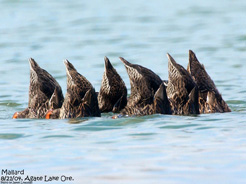
Ducks in a row ... Mallards foraging (c) Jim Livaudais 2016

WALK: We will get a chance to test our classroom knowledge in the field. Dick will plan a route that will give us our best chance of seeing the varied birdlife for which the Klamath Basin is famous – and we’ll have lots of fun doing it! Depending on water levels and weather conditions, there may be excellent opportunities for viewing thousands of migratory waterfowl.

March 4th Saturday 8:00AM 6:00PM


Cost: $25 for each talk and outing (or $50 makes you a member of KBO). Space is limited. Will schedule an extra outing day if needed. Contact – ShannonRio@aol.com with questions or to hold your spot.